Quick Summary: Engine compression testing is one of the most reliable ways to uncover hidden damage before buying a used car in India. For Rs 800 to Rs 1,500 at most independent workshops, this test reveals the true internal health of an engine — worn piston rings, burnt valves, failing head gaskets — that no visual inspection or test drive can detect. Cylinder readings below 100 PSI, or a variance of more than 15% between cylinders, are serious warning signs. In India's used car market, where maintenance histories are often incomplete and pre-sale cosmetic touch-ups are common, a compression test is not optional. It is essential due diligence.
Here is a situation many Indian used car buyers know. The car looks clean. The seller says full service done. The test drive feels smooth. The price seems fair. You are ready to sign.
Three months later, the engine starts burning oil. Or the car overheats on the highway. Or a mechanic tells you the head gasket has been leaking for a while — and someone clearly knew about it before selling.
This happens regularly in India's used car market. And in most cases, a simple engine compression test done before the purchase would have caught the problem. Yet most buyers skip it entirely — not because they do not care, but because no one told them it was an option.
What Standard Inspections Miss
Most pre-purchase checks in India focus on what is visible — panel condition, tyre wear, fluid levels, dashboard warning lights — but none of these tell you what is happening inside the engine's combustion chambers.An OBD scan reads fault codes stored in the car's computer. But many internal engine problems do not trigger fault codes early on. A worn piston ring. A slightly burnt valve. A head gasket that is beginning to fail. These conditions develop quietly, worsen over time, and do not announce themselves on a short test drive. This is exactly where compression testing fills the gap.
What a Compression Test Actually Does
A compression test measures the pressure each cylinder builds during the engine's compression stroke, revealing whether the internal components — piston rings, valves, cylinder walls, and head gasket — are sealing correctly.The mechanic removes all spark plugs, disables the fuel system, and cranks the engine while a pressure gauge measures the peak reading in each cylinder. Here is what the readings mean:
- 125–160 PSI with under 10% variance between cylinders: Healthy engine. Proceed with confidence.
- 110–125 PSI with under 10% variance: Acceptable on high-mileage vehicles. Monitor for oil consumption.
- Below 100 PSI in any cylinder, or variance exceeding 15%: Serious red flag. Renegotiate heavily or walk away.
- Below 90 PSI in any cylinder: Major internal damage. Walk away.
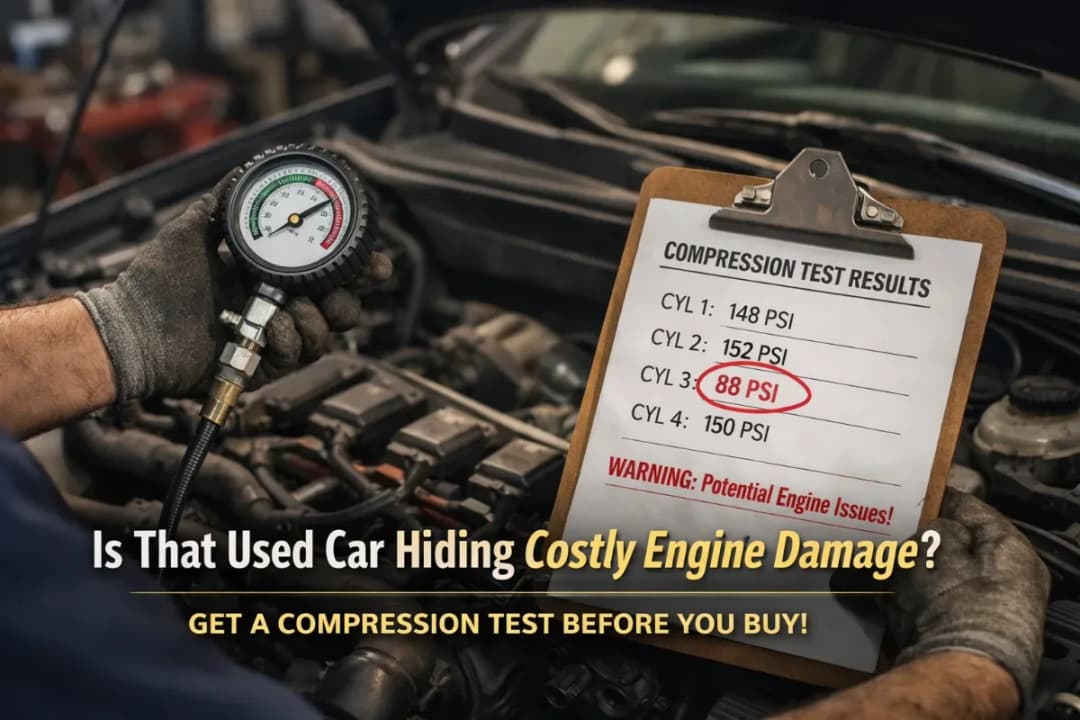
The variance between cylinders often matters more than the absolute numbers. An engine where all cylinders read 115 PSI is in better shape than one reading 148, 150, 88, and 145 PSI — even though the average might look acceptable.
What the Test Catches Before It Costs You
Compression testing identifies problems that are already developing — before they trigger warning lights, before they cause symptoms on a test drive, and before they result in repair bills that turn a good deal into a financial burden.- Worn piston rings allow combustion gases to escape past the piston. The engine burns oil, loses power, and eventually fails emission checks. In Indian conditions — where cars frequently sit in heavy traffic with the engine running hot — ring wear accelerates faster than most buyers expect.
- Burnt or damaged valves prevent the cylinder from sealing completely. Performance drops, fuel efficiency suffers, and the cylinder stops contributing to engine output.
- Head gasket failure allows coolant to mix with engine oil. This is among the most expensive engine repairs, and it is genuinely common on high-mileage Indian used cars that were run hot or had cooling systems neglected.
- Carbon buildup on valves is particularly common on direct-injection petrol engines, which have become more prevalent in India. Heavy deposits prevent valves from closing fully, reducing compression.
A real example: a car passes a basic inspection, shows no warning lights, and drives smoothly on a short test drive. But a compression test reveals one cylinder reading 82 PSI while the others are at 145–150 PSI. A follow-up leak-down test confirms a burnt exhaust valve. Repair estimate from a Bengaluru workshop: Rs 1,80,000 to Rs 2,20,000. A Rs 1,000 compression test would have changed everything.
What Engine Repairs Actually Cost in India
The gap between what a compression test costs and what it protects you from is significant — and in every case, the test pays for itself many times over.- Valve job (one cylinder): Rs 25,000 to Rs 60,000
- Head gasket replacement: Rs 18,000 to Rs 55,000 for hatchbacks and sedans; Rs 40,000 to Rs 90,000 for SUVs and diesel engines
- Piston ring replacement: Rs 60,000 to Rs 1,50,000 depending on engine size
- Complete cylinder head rebuild: Rs 70,000 to Rs 1,80,000
- Used engine replacement: Rs 80,000 to Rs 2,50,000
A compression test at a reputable independent workshop costs Rs 800 to Rs 1,500 for a four-cylinder engine, and up to Rs 2,000 for a six-cylinder. Adding a leak-down test brings the total to Rs 1,500 to Rs 3,500. Against what engine repairs cost in India, this is among the best money a used car buyer can spend.
Why Indian Road Conditions Make This Test More Important
India's driving environment is harder on engines than almost any other market — sustained idling in city traffic, frequent short trips, and flood exposure create conditions that accelerate internal engine wear in ways that only compression testing reveals.Long idling in bumper-to-bumper traffic in cities like Delhi, Mumbai, Pune, and Bengaluru generates sustained heat without the airflow that highway driving provides. Frequent short trips prevent the engine from reaching proper operating temperature, which accelerates wear. Cars that spent years in waterlogged areas can suffer internal damage that only shows up in compression numbers.
This is especially true for used diesel cars — Maruti Ertiga diesel, Hyundai Creta diesel, Toyota Innova Crysta — where compression ratios are much higher and the consequences of internal wear are more severe and more expensive to fix. Diesel compression testing requires a diesel-specific gauge and a mechanic experienced with diesel diagnostics. Target ranges are 300 to 500 PSI depending on the engine.
How to Get It Done Before You Buy
The process is straightforward — but it requires asking for it before negotiating price, choosing your own mechanic, and using the results as documented evidence rather than a gut feeling.Ask the seller upfront. Tell the seller before negotiating that you want a pre-purchase inspection including a compression test. Most genuine private sellers will agree immediately. If a seller refuses, treat that refusal as a serious red flag and walk away.
Choose your own independent mechanic. Do not use a mechanic the seller recommends. Find a trusted multi-brand workshop with no connection to the seller. Get the permission confirmed in writing — a WhatsApp message from the seller is sufficient.
Ask for both compression and leak-down testing. Compression testing tells you the pressure reading. Leak-down testing tells you exactly where the pressure is escaping — rings, valves, or head gasket. Ask the mechanic to document all individual cylinder readings, the variance between cylinders, and wet compression results for any cylinder that reads low.
A wet compression test is worth asking for on any cylinder that shows a low reading. The mechanic adds a small amount of oil through the spark plug hole and retests. If compression improves significantly, the piston rings are worn. If it stays low, the problem is more likely a valve — which is generally more expensive to fix.
Review results before making any offer. Good numbers confirm the asking price is fair. Poor numbers become documented leverage. Get a repair estimate from the mechanic before returning to the seller, and present both the test results and the estimate together. Ask for a price reduction that reflects the full cost of the repair. NX Car's pre-purchase inspection process includes compression testing as a core evaluation step — because the engine's internal health is the one thing no visual check or test drive can honestly tell you.
FAQs
What does a compression test reveal that a test drive cannot?
A compression test measures the actual sealing condition of each cylinder — worn piston rings, burnt valves, failing head gaskets. These problems develop gradually and produce no obvious symptoms during a short test drive, especially if the seller warmed the car up beforehand.
How much does a compression test cost at an Indian workshop?
Rs 800 to Rs 1,500 for most four-cylinder petrol engines. Adding a leak-down test brings the total to Rs 1,500 to Rs 3,500. Mobile pre-purchase inspection services that come to the seller's location typically charge Rs 3,000 to Rs 8,000 for a comprehensive check including compression testing.
What readings should I look for on a used petrol car?
Healthy readings are 125 to 160 PSI per cylinder with under 10% variance between cylinders. Below 100 PSI in any cylinder, or variance exceeding 15%, is a serious red flag. Below 90 PSI in any cylinder is generally a reason to walk away.
What if the seller refuses a compression test?
Treat the refusal as a serious red flag. Sellers with nothing to hide have no reason to object. A refusal almost always means the seller knows something about the engine's condition that they do not want you to discover before the sale.
Is compression testing relevant for diesel cars?
Yes, and arguably more important. Diesel engines run at much higher compression ratios (300 to 500 PSI) and the consequences of internal wear are more severe and more expensive to repair. Ensure the mechanic has a diesel-specific compression gauge and experience with diesel engine diagnostics.