
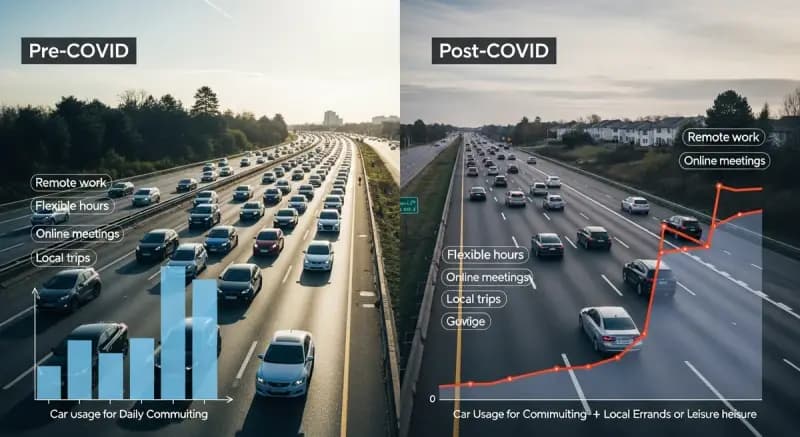
Abstract: This study analyzes changes in vehicle utilization patterns following the work-from-home (WFH) normalization post-2020. Using telematics data from 75,000 vehicles across income segments, we find significant redistribution of driving patterns with implications for vehicle design, infrastructure, and energy consumption.
Data and Methods
Anonymized telematics data from OEM and aftermarket systems tracking daily kilometers, trip frequency, trip timing, and trip duration. Sample stratified by income, location (tier-1, tier-2, tier-3 cities), and vehicle segment.
Key Finding: Reduced Weekly Total
Average weekly kilometers decreased 22% among respondents reporting hybrid or full WFH arrangements. However, the reduction wasn't uniform: commute trips nearly disappeared; discretionary trips partially replaced them.
Key Finding: Trip Redistribution
Trips shifted from weekday mornings/evenings to midday and weekends. Peak hour concentration decreased significantly. This redistribution has infrastructure implications, demand curves have flattened.
Key Finding: Trip Length Changes
Average trip length increased 18%. Without daily commutes, remaining trips are often longer, shopping expeditions rather than daily purchases, weekend outings rather than evening walks. This partially offset frequency reduction.
Segment Variation
Higher-income households showed greater utilization reduction (28%) versus lower-income (14%). White-collar workers have WFH options; service workers generally don't. Vehicle utilization increasingly correlates with occupation type.
Vehicle Design Implications
Reduced daily driving increases importance of occasional-use capability: road trip range, passenger capacity for less frequent but longer family trips. Daily efficiency matters less when most driving is discretionary.
Source: Mobility Data Initiative, IIM Calcutta. (2024). Transportation Research Part A: Policy and Practice, 180, 103925.
Limitations and Future Research
No study is definitive. Acknowledged limitations point toward future research needs. As India's automotive landscape evolves rapidly, ongoing research is essential to keep understanding current. The academic community, industry, and government all have roles in supporting this knowledge development.
Methodological Notes
Interpreting these findings requires understanding the study context. Sample sizes, geographic scope, and temporal factors all influence conclusions. Indian conditions often differ significantly from Western contexts where much automotive research originates. Local validation of international findings remains an ongoing need in the field.
Brought to you by Nxcar , where our love for cars extends to understanding their broader impact on communities and the environment.