Abstract: Women's mobility patterns differ systematically from men's due to safety concerns, household responsibilities, and transport design biases. This mixed-methods study examines gender disparities in urban mobility access and experience with recommendations for inclusive transport planning.
Quantitative Findings
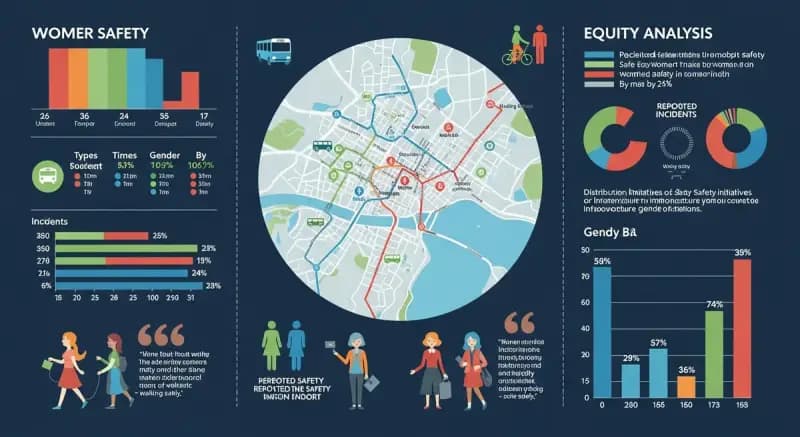
Survey data (n=8,000 across four cities) revealed: women make 35% fewer motorized trips than men; women's trips average 40% shorter; women's mode choice strongly favors auto-rickshaws and app-based cabs over buses; women's peak travel times differ from men's.
Safety Concerns
65% of women reported modifying travel behavior due to safety concerns: avoiding certain routes (78%), avoiding certain times (85%), choosing more expensive modes (63%). Safety concerns restrict mobility options systematically.
Infrastructure Gaps
Women identified: inadequate lighting at transit stops (87% concerned), crowding enabling harassment (82%), absence of women-only options (68%), poor last-mile connectivity requiring walking through unsafe areas (75%).
Household Burden
Women's trips frequently involve child/elderly accompaniment (45% versus 12% for men), shopping/household errands (52% versus 28%), and trip-chaining (multiple destinations per journey). Transport design assuming single-purpose trips disadvantages women's actual patterns.
Economic Impact
Mobility restrictions affect women's employment options. 34% of women reported declining job opportunities due to commute concerns. Transportation barriers reinforce gender employment gaps.
Policy Recommendations
Safety-focused infrastructure investment: lighting, cameras, emergency communications. Women-only transit options during peak hours. Fare structures recognizing trip-chaining needs. Design consultation with women users, not assumptions about needs.
Source: Azim Premji University Centre for Sustainable Development. (2024). Transport Policy, 147, 103568.
Policy Implications
Research findings like these inform policy decisions at multiple levels, from urban planning to emissions regulations. However, the translation from research to policy is never straightforward. Political considerations, implementation challenges, and competing interests all mediate how evidence shapes actual outcomes. Engaged citizens can advocate for evidence-based policymaking.
Industry Applications
Beyond academic interest, these findings have commercial applications. Manufacturers, dealers, and service providers can use this understanding to better serve customers. Some will embrace these insights; others will resist change. Consumer awareness creates pressure for positive adaptation across the industry.
The Nxcar team is passionate about the science of mobility as much as the joy of driving. This study reflects both.