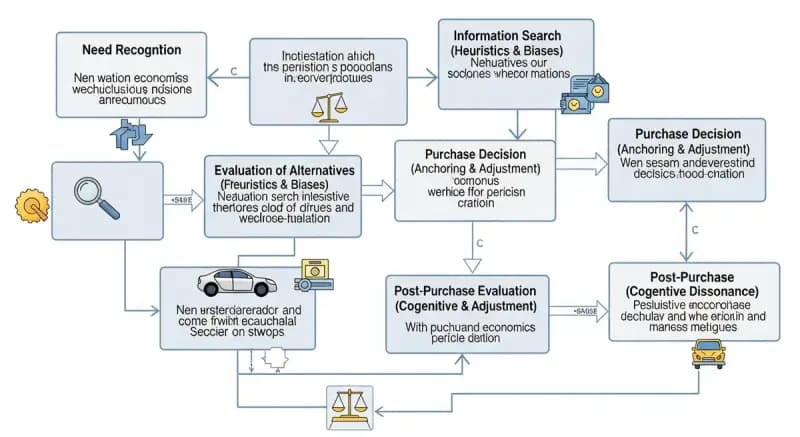
Abstract: This field study examines how behavioral economics concepts, anchoring, framing, and loss aversion, influence vehicle purchase decisions among Indian consumers. Analysis of 3,200 buyer interactions reveals systematic biases that manufacturers exploit through pricing and promotion strategies.
Research Framework
Classical economics assumes rational utility maximization in purchase decisions. Behavioral economics recognizes systematic cognitive biases affecting choices. This study applies behavioral frameworks to automotive purchasing, examining how biases manifest in real transactions.
Anchoring Effects
Experimental manipulation of initial price presentations significantly affected willingness-to-pay. When first shown higher-priced variants, subjects perceived mid-variants as better value, even when absolute price was identical to control conditions where mid-variants were shown first.
Dealers exploit anchoring by beginning negotiations from maximum price points, making any discount feel like victory regardless of absolute value.
Framing Analysis
Identical financial outcomes framed differently produced different decisions. Monthly EMI presentations increased purchase probability versus total cost presentations, despite identical economic value. Financing framing obscures true costs.
Loss Aversion
Subjects exhibited stronger reactions to potential losses than equivalent gains. Missing out on limited-time offers motivated purchases more than equivalent permanent discounts. Scarcity framing activates loss aversion, driving hasty decisions.
Implications
Consumer education about cognitive biases could improve decision quality. Regulatory requirements for transparent total-cost presentation would reduce framing exploitation. Understanding these dynamics helps buyers recognize manipulation tactics.
Source: Behavioural Economics Lab, IIM Ahmedabad. (2024). Journal of Consumer Psychology, 34(2), 156-178.
Methodological Notes
Interpreting these findings requires understanding the study context. Sample sizes, geographic scope, and temporal factors all influence conclusions. Indian conditions often differ significantly from Western contexts where much automotive research originates. Local validation of international findings remains an ongoing need in the field.
Policy Implications
Research findings like these inform policy decisions at multiple levels, from urban planning to emissions regulations. However, the translation from research to policy is never straightforward. Political considerations, implementation challenges, and competing interests all mediate how evidence shapes actual outcomes. Engaged citizens can advocate for evidence-based policymaking.
Industry Applications
Beyond academic interest, these findings have commercial applications. Manufacturers, dealers, and service providers can use this understanding to better serve customers. Some will embrace these insights; others will resist change. Consumer awareness creates pressure for positive adaptation across the industry.
This research was curated by Nxcar's team, driven by our belief that understanding mobility shapes better decisions for individuals and society.