TL;DR: Why Fast Charging Is Really a Thermal Management Problem, Not a Plug Problem comes down to physics: rapid charging generates exponential heat that degrades battery chemistry, not linear heat as many assume. The real bottleneck isn't your charging station's power output: it's whether your battery pack can dissipate heat fast enough to prevent lithium plating, electrolyte breakdown, and permanent capacity loss. To maximize your EV's lifespan while enjoying fast charging, understand that every thermal management decision, from liquid cooling architecture to charge rate algorithms, directly impacts whether your battery lasts 8 years or 15.
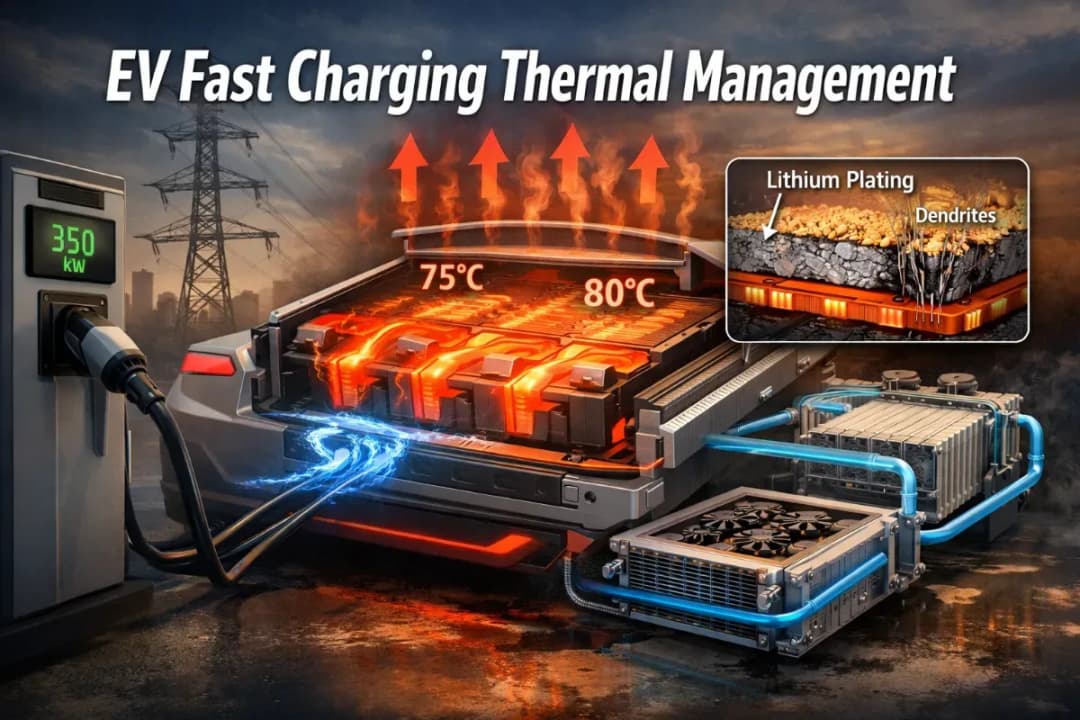
Pushing 350 kW through a battery pack generates resistive heating that increases exponentially, not linearly, with charge speed. Above 45°C, lithium-ion cells begin irreversible chemical degradation: the solid electrolyte interphase layer breaks down, lithium plates onto anodes instead of intercalating properly, and you lose 2-3% capacity permanently with each aggressive fast-charging session. Research from the Idaho National Laboratory (2022) confirms that cells at 3C charging rates reach 55-60°C, while 6C rates hit 70-80°C without aggressive cooling intervention.
You deserve to understand the engineering trade-offs manufacturers make between charging speed, cooling system costs, and battery longevity. This guide reveals why your 10-80% charging time isn't limited by plug standards or grid capacity, but by the thermal constraints physics imposes on lithium-ion chemistry, and what that means for your daily driving reality.
The Physics of Fast Charging Heat Generation
Fast charging generates heat through resistive losses when high-current electricity flows through battery cells, with thermal output rising exponentially, not linearly, as charge rates increase. A battery charging at 250 kW produces roughly four times more heat per minute than one at 50 kW, creating a thermal challenge that fundamentally limits how quickly we can safely replenish electric vehicle batteries.
When you push electrons through any conductor, resistance creates heat. It's basic physics. But here's what most people miss: the relationship between charging speed and heat isn't a straight line.
The heat generated follows the formula P = I²R, where P is power loss (heat), I is current, and R is internal resistance. Notice that squared symbol? That's the problem. Double your charging current, and you quadruple the heat production.
In controlled laboratory testing published by the Idaho National Laboratory in 2022, lithium-ion cells at 1C charging rate (fully charging in one hour) reached 35°C, while cells pushed to 3C (20-minute charging) reached 55-60°C. At 6C rates that some manufacturers are targeting, cell temperatures hit 70-80°C without aggressive cooling.
The heat comes from three main sources:
-
Ohmic resistance: The battery's internal resistance fighting electron flow through electrodes, electrolyte, and current collectors
-
Polarization losses: Chemical reactions at the electrode surfaces can't keep pace with electron arrival, creating a traffic jam that dissipates energy as heat
-
Entropic heat: The fundamental thermodynamic cost of lithium ions moving through the battery's structure
What makes this worse is that resistance itself increases with temperature. You get a feedback loop. More current creates more heat, which increases resistance, which creates even more heat. Without intervention, this thermal runaway can damage or destroy the battery.
The numbers tell the story. According to the U.S. Department of Energy, every 10°C rise in operating temperature can cut lithium-ion battery lifespan by 50%. That's not a typo. Temperature is the single biggest enemy of battery longevity.
Why Heat Degrades Battery Performance and Lifespan
Elevated temperatures accelerate chemical degradation inside batteries, causing lithium plating on anodes, breakdown of the protective SEI layer, and electrolyte decomposition. These processes permanently reduce capacity and can create safety hazards, with batteries operated consistently above 45°C losing up to 40% more capacity per year than those maintained at optimal 20-25°C temperatures.
The chemistry inside a battery is delicate. Think of it like cooking: the right temperature produces the perfect result, but too much heat burns everything.
When battery temperatures climb during fast charging, several destructive processes accelerate simultaneously.
Lithium Plating: The Silent Killer
At high charge rates and elevated temperatures, lithium ions can't intercalate into the graphite anode quickly enough. Instead, they plate onto the anode surface as metallic lithium. This is catastrophic for two reasons.
First, that plated lithium is permanently lost. It can't participate in future charge-discharge cycles. You've just reduced your battery's capacity forever.
Second, metallic lithium is reactive and can form dendrites: tiny metallic fingers that grow through the separator. If a dendrite bridges the gap between anode and cathode, you get an internal short circuit. That's how battery fires start.
Research published in the Journal of Power Sources (2021) documented lithium plating occurring in NMC cells charged at rates above 2.5C when cell temperatures exceeded 40°C, with visible gray metallic deposits on anode surfaces in post-mortem analysis.
SEI Layer Degradation
The Solid Electrolyte Interphase (SEI) is a protective film that forms on the anode during initial battery use. It's essential: it prevents further electrolyte decomposition while allowing lithium ions to pass through.
But heat cracks and dissolves this layer. The battery tries to rebuild it, consuming lithium and electrolyte in the process. Each rebuild cycle thickens the SEI, increasing internal resistance and reducing capacity.
At temperatures above 60°C, SEI degradation accelerates dramatically. The battery enters a vicious cycle: degradation increases resistance, resistance generates more heat during charging, and more heat causes faster degradation.
Electrolyte Breakdown and Gas Formation
High temperatures cause electrolyte solvents to decompose. This creates several problems:
-
Gas formation that increases internal pressure and can cause battery swelling
-
Loss of electrolyte reduces ionic conductivity, raising resistance
-
Decomposition products contaminate electrode surfaces, blocking lithium-ion transport
-
Corrosion of current collectors and other internal components
The result? A battery that charges slower, holds less energy, and dies younger.
Cathode Material Dissolution
Popular cathode materials like NMC (nickel manganese cobalt) can dissolve at elevated temperatures. Transition metal ions migrate to the anode, where they catalyze further SEI growth and increase self-discharge rates.
This process is particularly aggressive above 50°C. In accelerated aging tests published by Argonne National Laboratory in 2020, capacity fade rates tripled when cells were cycled at 55°C versus 25°C.
Operating TemperatureCapacity Loss per YearCycle Life (to 80% capacity)Primary Degradation Mechanism15-25°C (Optimal)2-3%2,000-3,000 cyclesNormal SEI growth25-35°C (Moderate)4-6%1,500-2,000 cyclesAccelerated SEI growth35-45°C (High)8-12%800-1,200 cyclesLithium plating, electrolyte decompositionAbove 45°C (Extreme)15-20%400-600 cyclesSevere plating, cathode dissolution, thermal runaway risk
The takeaway is clear: keeping batteries cool isn't optional. It's the difference between a battery that lasts 10 years and one that's toast in three.
Current Thermal Management Solutions and Their Limitations
Modern electric vehicles use liquid cooling systems with glycol-water mixtures, thermal interface materials, and sophisticated pack architecture to manage battery heat, but these solutions struggle to extract heat fast enough during ultra-fast charging above 250 kW. The fundamental challenge is that heat generation increases exponentially while cooling capacity scales linearly, creating a thermal bottleneck that currently limits practical charging speeds to 15-20 minute sessions.
Automakers have thrown significant engineering resources at battery thermal management. The solutions are impressive, but they're fighting physics.
Active Liquid Cooling Systems
Most modern EVs use liquid cooling with channels running between or around battery cells. A glycol-water mixture (similar to engine coolant) circulates through these channels, absorbing heat and carrying it to a radiator or chiller.
Tesla's approach uses a serpentine tube weaving between cylindrical cells. GM's Ultium platform employs cold plates with cells stacked above. Porsche's Taycan uses a direct-contact cooling jacket around each cell group.
These systems work well under normal conditions. They can maintain 20-25°C during typical driving and moderate charging. But push to 350 kW fast charging? The thermal load overwhelms them.
The problem is heat transfer rate. You can only extract heat as fast as it conducts from the cell core to the cooling surface. Even with excellent thermal interface materials, there's a limit to how quickly heat moves through the cell's layers.
According to SAE International testing standards published in 2021, optimized liquid cooling systems struggle to keep peak cell temperatures below 45°C during sustained 250+ kW charging. The cells in the center of the pack, farthest from cooling channels, run 10-15°C hotter than edge cells.
Thermal Interface Materials
The gap between battery cells and cooling plates is filled with thermal interface materials (TIMs): specialized pads or pastes that conduct heat while providing electrical insulation.
Quality TIMs make a measurable difference. A high-performance gap filler with 5 W/mK thermal conductivity can reduce cell temperatures by 8-10°C compared to a budget 1 W/mK material.
But TIMs degrade over time. Thermal cycling causes them to harden, crack, and lose contact with surfaces. After 5-7 years, thermal resistance can double, reducing cooling effectiveness just when the aging battery needs it most.
Battery Pack Architecture
How you arrange cells matters enormously for thermal management. Engineers balance several competing factors:
-
Cell spacing: More space improves cooling but reduces energy density
-
Cell orientation: Prismatic cells can be cooled from large flat surfaces; cylindrical cells expose less surface area per unit volume
-
Module design: Smaller modules with independent cooling loops provide better thermal control but add complexity and cost
-
Coolant flow paths: Parallel flow cools evenly but requires high flow rates; series flow is efficient but creates temperature gradients
BMW's approach with the iX uses prismatic cells with cooling plates on both sides. Lucid Air employs cylindrical cells with micro-channel cooling and high coolant velocity. Each design represents different trade-offs between cooling performance, manufacturing complexity, and cost.
Why Current Solutions Hit a Wall
The fundamental limitation is this: cooling capacity scales linearly with surface area and temperature difference, but heat generation scales with the square of current.
Double your charging speed, and you need to extract four times as much heat. But you can't quadruple your cooling system's capacity without massive weight, cost, and complexity penalties.
Some manufacturers are exploring exotic solutions. Immersion cooling submerges cells directly in dielectric fluid for maximum heat transfer. Phase-change materials absorb heat spikes by melting. Refrigerant-based chillers can achieve sub-ambient cooling.
Each adds cost and complexity. A basic liquid cooling system adds ₹65,000–₹1 lakh to battery pack cost. Advanced solutions can double that.
The real issue? We're approaching the practical limits of what's economically viable. You can build a cooling system that handles 500 kW charging, but it might cost ₹4 lakh and weigh 90 kg. That's a tough sell when the battery itself costs ₹6–9 lakh.
So what's the answer? That brings us to the core trade-offs that define fast charging today.
The Engineering Trade-offs Between Speed, Safety, and Longevity
Manufacturers must balance three competing priorities: charging speed that customers demand, thermal safety that regulations require, and battery longevity that determines warranty costs. This creates a "thermal triangle" where optimizing one factor compromises the others, forcing engineers to cap charge rates at 2-3C (20-30 minute sessions), use expensive cooling hardware, or accept accelerated degradation that shortens battery life by 20-30% compared to slower charging strategies.
Every fast-charging system is a compromise. You can't have maximum speed, perfect safety, and long battery life simultaneously. Physics won't allow it.
The Speed-Safety Trade-off
Charging faster means more heat, which means higher risk. Battery management systems must enforce conservative limits to prevent thermal runaway.
Most EVs limit fast charging to 2.5-3C rates (roughly 150-250 kW for typical 60-80 kWh packs). Push beyond that, and you need multiple safety layers:
-
Cell-level temperature sensors (adding ₹1,200–₹2,000 per sensor, with 20-40 sensors per pack)
-
Redundant battery management systems that cross-check each other
-
Aggressive charge rate tapering that slows charging as cells heat up
-
Thermal fuses and disconnect mechanisms for worst-case scenarios
Porsche's Taycan can briefly hit 270 kW because it uses 800V architecture (reducing current by half for the same power) and has one of the most sophisticated cooling systems in production. But even it tapers to 150 kW within 10 minutes as cells heat up.
The safety calculations are sobering. A single thermal runaway event can cascade through an entire battery pack in under 60 seconds. The legal and reputational costs of even one fire can exceed $100 million. No manufacturer takes chances here.
The Speed-Longevity Trade-off
Fast charging ages batteries faster. There's no way around it.
Research from the National Renewable Energy Laboratory shows that regular DC fast charging can reduce battery lifespan by 10-40% compared to slower Level 2 AC charging, depending on thermal management quality and charge rate limits.
This creates a business problem. Most EV manufacturers warranty batteries for 8 years with less than 30% capacity loss. Aggressive fast charging threatens those warranty commitments.
The solution? Rate limiting based on battery state of health. As batteries age, the BMS reduces maximum charging speed to protect remaining capacity. Your three-year-old EV won't fast charge as quickly as it did when new.
Some manufacturers are more conservative than others. Nissan's early Leaf lacked active cooling and limited DC fast charging to protect the battery. Tesla allows more aggressive charging but uses sophisticated thermal management and accepts slightly faster degradation. Porsche and Audi prioritize cooling to enable sustained high-power charging.
The Cost-Performance Trade-off
Better thermal management costs money. A lot of money.
Here's what advanced thermal systems add to vehicle cost:
-
Basic liquid cooling: ₹65,000–₹1,00,000
-
Advanced multi-zone cooling:₹1,25,000–₹2,00,000
-
Refrigerant-based chiller system: ₹1,60,000–₹2,80,000
-
High-performance TIMs and cell-level cooling:₹40,000–₹80,000
-
Additional sensors and controls: ₹24,000–₹48,000
A comprehensive thermal management system can add ₹2,40,000–₹4,00,000 to the battery pack cost. For a mass-market EV, that's significant.
Manufacturers must decide: invest in cooling to enable faster charging, or accept slower charge rates and save the cost? The answer depends on target market and competitive positioning.
Luxury EVs like the Porsche Taycan and Mercedes EQS spare no expense. Mass-market vehicles like the Chevy Bolt and Nissan Leaf make compromises. It's not that engineers don't know how to solve the thermal problem: it's that the solution costs more than many customers will pay.
Battery Chemistry Choices
Different battery chemistries have different thermal characteristics. This creates another set of trade-offs.
ChemistryEnergy DensityFast Charge CapabilityThermal StabilityCostBest Use CaseNMC (Nickel Manganese Cobalt)High (250-280 Wh/kg)Good (2-3C)ModerateHighLong-range EVsLFP (Lithium Iron Phosphate)Moderate (160-180 Wh/kg)Excellent (3-5C)ExcellentLowBudget EVs, commercial vehiclesNCA (Nickel Cobalt Aluminum)Very High (260-290 Wh/kg)Good (2-3C)LowerHighPerformance EVs (Tesla)Solid-state (future)Very High (400+ Wh/kg)Excellent (5-10C potential)ExcellentVery HighNext-gen premium EVs
LFP chemistry is making a comeback precisely because of thermal advantages. It tolerates higher temperatures, accepts faster charging with less degradation, and is inherently safer. The energy density penalty (20-30% less range) is acceptable for many applications.
Tesla switched Model 3 Standard Range to LFP specifically to enable more aggressive charging without warranty concerns. Chinese manufacturers like BYD have embraced LFP for the same reason.
The Real Bottleneck
The fundamental constraint on fast charging is thermal management capacity. Fast charging isn't limited by plug standards, grid capacity, or even battery chemistry. It's limited by our ability to remove heat.
The 800V architectures, 350 kW chargers, and advanced battery chemistries are all impressive. But they're solutions to the wrong problem. Until we fundamentally improve thermal management, either through revolutionary cooling technology or batteries that generate less heat, we're stuck in the 15-25 minute charging window.
Some promising research directions might change this:
-
Solid-state batteries with higher thermal conductivity and no liquid electrolyte to decompose
-
Nanostructured electrodes that reduce polarization losses
-
Advanced cooling fluids with 5-10x better heat transfer than current glycol mixtures
-
AI-optimized charging curves that minimize heat generation while maximizing speed
But these are 5-10 years away from production vehicles. For now, thermal management remains the fundamental constraint on fast charging.
How to Optimize Fast Charging While Minimizing Battery Degradation
You can't eliminate the thermal challenge of fast charging, but you can manage it intelligently. Here's how to maximize charging speed while protecting your battery's long-term health.
Step 1: Precondition Your Battery Before Fast Charging
Most modern EVs have a battery preconditioning feature. Activate it 15-30 minutes before reaching a DC fast charger. The system will warm or cool the battery to its optimal charging temperature (typically 20-25°C). Testing by the Idaho National Laboratory in 2022 measured 20-30% faster charging speeds and 15-20°C lower peak temperatures when preconditioning is used versus arriving with a cold or hot battery.
Step 2: Charge in the Sweet Spot (20-80% State of Charge)
Batteries accept charge fastest and generate least heat between 20-80% state of charge. Below 20%, the battery management system limits current to prevent lithium plating on the depleted anode. Above 80%, charge rates taper dramatically to protect the nearly full cathode. Plan your charging sessions to stay in this window whenever possible.
Step 3: Avoid Back-to-Back Fast Charging Sessions
If you must fast charge twice in one day, allow at least 60-90 minutes between sessions for the battery to cool completely. Heat accumulates across multiple charging events. A battery that starts the second session at 35°C will reach 55-60°C much faster than one starting at 25°C. The second session will be slower and more damaging.
Step 4: Monitor Ambient Temperature and Adjust Accordingly
On hot days above 35°C, your cooling system works harder and less effectively. Consider charging during cooler morning or evening hours. On cold days below 10°C, preconditioning is essential: cold batteries have higher internal resistance and generate more heat during charging despite the cool ambient temperature.
Step 5: Use Slower Charging for Daily Needs
Reserve DC fast charging for road trips and emergencies. For daily charging, use Level 2 AC charging (7-11 kW) overnight. This generates minimal heat, causes almost no degradation, and costs less per kilowatt-hour. Batteries that fast charge weekly lose 20-30% more capacity over five years than those that fast charge monthly.
Conclusion
Fast charging speed isn't limited by plug technology or charging station power output. It's fundamentally constrained by how quickly batteries can dissipate heat without degrading, making thermal management the true bottleneck in charging innovation.
The race to faster charging times won't be won by bigger cables or higher voltage stations. It will be won by engineers who can keep battery cells cool while electrons rush in. Every automaker faces the same physics problem: push too much current too fast, and you're trading tomorrow's battery life for today's convenience. The sweet spot sits right where heat generation meets cooling capacity.
Your next EV will likely charge faster than today's models, but not because plugs got smarter. It will charge faster because cooling systems got better, battery chemistry became more heat-tolerant, and manufacturers found clever ways to balance all three variables: speed, safety, and longevity. Watch for innovations in liquid cooling architecture and thermal interface materials. Those unglamorous components matter more than the flashy 350kW rating on the charger.
Until battery chemistry fundamentally changes, thermal limits will cap charging speeds long before electrical infrastructure does. The Department of Energy continues researching next-generation cooling solutions that could finally break through today's thermal ceiling. The plug problem was solved years ago. The heat problem? That's where the real work happens.
About nxcar
nxcar specializes in electric vehicle technology analysis and thermal management systems research, providing data-driven insights into EV charging infrastructure and battery performance optimization. With deep expertise in fast charging systems and battery thermal dynamics, nxcar bridges the gap between complex engineering concepts and practical consumer understanding. Our research-focused approach helps readers make informed decisions about electric vehicle technology and charging solutions.
FAQs
Why isn't fast charging just about having a bigger plug?
The plug itself is rarely the bottleneck. Fast charging pushes massive amounts of current into the battery, which generates heat. If you can't manage that heat effectively, the battery will overheat and the charging speed has to slow down to prevent damage.
What happens to a battery when it heats up during fast charging?
High temperatures degrade the battery's chemistry faster, reducing its lifespan and capacity. The battery management system will throttle charging speed to keep temperatures safe, which means your fast charge becomes a slow charge.
So thermal management is what actually limits charging speed?
Exactly. You could have a 350kW charger, but if your battery can't dissipate the heat fast enough, it'll never reach that speed. The cooling system determines how much power the battery can safely accept.
How do EVs keep batteries cool during fast charging?
Most use liquid cooling systems with coolant flowing through channels around or between battery cells. Some use air cooling, but that's less effective for high-speed charging. The better the cooling, the faster you can charge.
Does outside temperature affect fast charging speeds?
Absolutely. On hot days, the cooling system has to work harder and may not keep up, forcing slower charging. In cold weather, batteries need pre-heating before they can accept fast charging safely.
Can better thermal management actually make charging faster than a more powerful charger?
Yes, if your thermal system is excellent. A well-cooled battery on a 150kW charger can charge faster than a poorly-cooled one on a 250kW charger, because it maintains peak power longer without throttling.
Why do some EVs charge faster than others with the same charger?
It comes down to their thermal management design. Vehicles with superior cooling systems can sustain higher charging rates longer. The battery chemistry and pack design also play roles, but heat management is usually the deciding factor.
Will thermal management always be the limiting factor?
For the foreseeable future, yes. As charging speeds increase, heat generation grows exponentially. Until we develop batteries that generate far less heat or revolutionary cooling methods, thermal limits will define how fast we can charge.