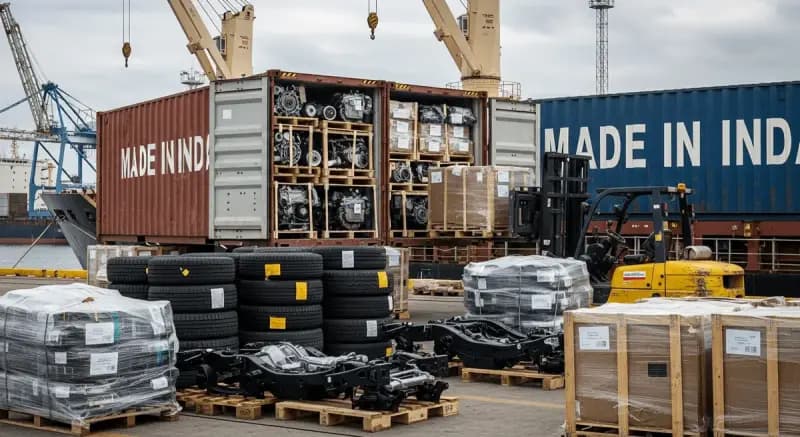
India's automotive component industry has achieved record exports of $22 billion in fiscal year 2024, establishing the country as a critical node in global automotive supply chains. The milestone represents a 15% increase over the previous year and positions India as the world's fifth-largest auto components manufacturer.
The Automotive Component Manufacturers Association (ACMA) announced the figures at its annual convention, highlighting India's evolution from a low-cost manufacturing destination to a comprehensive engineering hub.
Export Composition
Drive transmission and steering components lead exports at $5.8 billion, followed by engine components at $4.2 billion, and suspension/braking systems at $3.7 billion. Electrical and electronic components are the fastest-growing category, increasing 32% year-over-year as vehicles become increasingly computerized.
Related Reading
Stop Comparing Cars on YouTube: Here's Why Reviews Are UselessEurope remains the largest export destination at 34% of total exports, followed by North America at 27%, and Asia at 22%. Notably, exports to traditional competitors like Thailand and Mexico have increased, suggesting Indian components are displacing local production in these markets.
Key Success Factors
"We've moved up the value chain," explained ACMA President Vinnie Mehta. "We're no longer just producing commodity components. Indian companies are winning contracts for complex systems, turbochargers, and electronic control units that were previously sourced from Europe or Japan."
Government policies have supported this transition. The Production Linked Incentive scheme for auto components provides cash incentives for incremental production and exports. Free trade agreements with ASEAN and prospective agreements with the EU and UK will further enhance competitiveness.
EV Transition Impact
The shift to electric vehicles presents both challenges and opportunities. While demand for engine and transmission components will decline, new opportunities emerge in battery housings, electric motor components, and power electronics.
Major component makers including Motherson Sumi, Samvardhana Motherson, and Bharat Forge are investing heavily in EV-specific manufacturing capabilities.
Consumer Perspective
For Indian car buyers, these changes present both opportunities and considerations. Price-conscious consumers may find new value propositions emerging, while those focused on long-term ownership costs should factor in evolving technology and service networks. The market is becoming increasingly sophisticated, requiring buyers to make more informed decisions.
Regional Variations
The impact will vary across different Indian markets. Metropolitan areas with higher purchasing power may see accelerated adoption of new technologies and brands. Tier-2 and Tier-3 cities, which increasingly drive automotive sales growth, will likely follow different adoption curves based on infrastructure readiness and price sensitivity.
Looking Ahead
As the Indian automotive market matures, developments like these reshape the competitive landscape. The coming years will reveal which players successfully navigate these transitions and which struggle to adapt. Consumers ultimately benefit from increased competition and innovation, though the transition period may bring uncertainty for some segments.
At Nxcar, our team shares an undying love for automobiles and the stories behind them. This article is a testament to that passion.