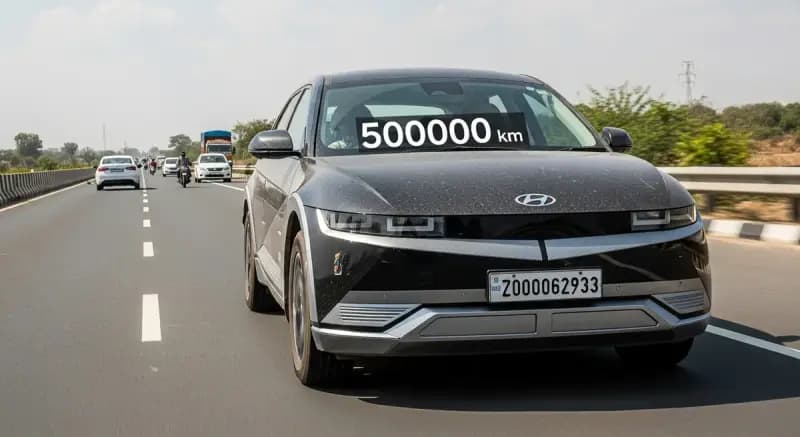
After 18 months and 50,000 kilometers with the Hyundai Ioniq 5, this comprehensive long-term review provides insights that short test drives cannot capture. From real-world efficiency to ownership costs, here's what extended EV ownership teaches you.
Efficiency Reality
Hyundai claims 6.1 km/kWh (WLTP). My real-world average: 5.4 km/kWh, 12% below claimed. This includes highway driving (120-130 km/h reduces efficiency significantly), AC usage in Pune summers (adds 15% consumption), and spirited driving when the performance tempts.
At domestic electricity rates of Rs 8/kWh, my running cost is Rs 1.48/km. A comparable petrol SUV (12 km/l, Rs 110 petrol) costs Rs 9.17/km. Annual savings at 35,000 km: Rs 2.7 lakh. The running cost advantage is real and substantial.
Related Reading
Auto Component Sector Achieves Record Exports of $22 BillionBattery Degradation
At 50,000 km, the battery shows 97% of original capacity per the car's diagnostics. The 72.6 kWh usable capacity has become ~70.4 kWh. Degradation is tracking below Hyundai's warranty curve, suggesting the 70% capacity warranty should be easily exceeded.
This experience contradicts anxiety about EV battery longevity. Modern thermal management and battery chemistry deliver genuine durability.
Maintenance Experience
Total maintenance cost over 50,000 km: Rs 28,000. This includes two cabin filter changes, brake fluid replacement, and wiper changes. No brake pad replacement needed, regenerative braking means mechanical brakes hardly wear. Compare to a comparable ICE vehicle's Rs 80,000-100,000 maintenance cost.
Charging Patterns
Home charging covers 90% of my needs. I installed a 7.4 kW charger for Rs 45,000 (including installation). Overnight charging from 20-80% takes 5-6 hours and is utterly convenient, wake up to a charged car daily.
Public DC fast charging is used primarily for road trips. The 800V architecture enables 10-80% charge in 18 minutes at 350 kW stations, when available. Highway infrastructure remains the primary pain point.
Living With an EV
Related Reading
The Sound of Cars: From Engine Notes to Synthesized AudioThe adjustment is real but manageable. You think about charging differently than fueling, it's something you do while parked rather than a dedicated errand. Range anxiety fades after the first month as you learn actual consumption patterns.
What surprised me most: I don't miss the driving dynamics of my previous BMW. The Ioniq 5's instantaneous torque and planted handling are genuinely enjoyable. EVs aren't compromises, they're a different kind of excellent.
Real-World Applications
Theory translates to practice in specific ways. Under Indian driving conditions, with their unique combination of heat, dust, traffic, and road quality, these technical factors manifest differently than in laboratory conditions. Owners should calibrate expectations accordingly, recognizing that advertised specifications often assume ideal conditions.
Future Developments
Automotive technology continues evolving rapidly. What seems cutting-edge today becomes standard tomorrow. Understanding current technical foundations helps owners anticipate future developments and make purchase decisions that won't become obsolete prematurely. The pace of change, particularly in electrification and connectivity, makes this foresight increasingly valuable.
At Nxcar, we dig deep into automotive technology because informed enthusiasts make better owners.