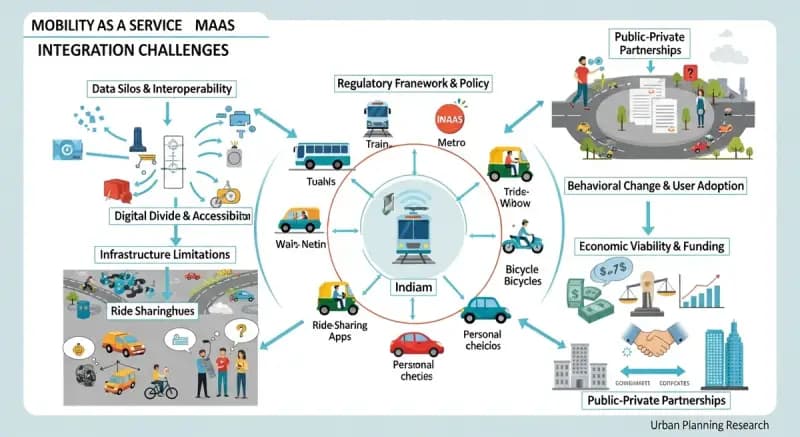
Abstract: Mobility-as-a-Service (MaaS) promises integrated multimodal transport booking through single platforms. This study examines implementation challenges in Indian cities through stakeholder analysis and pilot program evaluation. Results identify regulatory, technological, and behavioral barriers requiring policy attention.
MaaS Concept
MaaS integrates public transit, ride-sharing, bike-sharing, and potentially private vehicles into unified platforms enabling journey planning, booking, and payment. The promise: seamless mobility reducing private vehicle dependence.
Stakeholder Analysis
Interviews with transit authorities, ride-sharing companies, technology providers, and users across Mumbai, Bengaluru, and Hyderabad revealed divergent interests. Transit authorities fear revenue sharing complexity. Ride-sharing companies resist data sharing. Users want convenience but distrust unfamiliar platforms.
Pilot Evaluation
Analysis of three MaaS pilots (varying integration levels) showed: minimal uptake without first/last-mile integration; user satisfaction correlating with payment simplicity; failure when any integrated mode had poor service quality.
Regulatory Barriers
No framework exists for data sharing between public and private operators. Fare integration requires subsidy coordination across authorities. Liability for service failures across modes is undefined.
Technology Gaps
Real-time transit data availability is limited. Payment systems aren't interoperable. Journey planning algorithms struggle with mixed-traffic conditions where schedules are meaningless.
Behavioral Realities
Users prefer known options over integrated alternatives. Private vehicle owners resist mode shift despite MaaS convenience. Behavioral change requires not just availability but active incentivization.
Recommendations
Regulatory framework for transport data sharing is prerequisite. Pilot programs should ensure service quality across all modes before scaling. Subsidized integration can demonstrate value before commercial viability.
Source: Urban Transport Research Centre, IIT Madras. (2024). Transportation Research Part C: Emerging Technologies, 158, 104423.
Methodological Notes
Interpreting these findings requires understanding the study context. Sample sizes, geographic scope, and temporal factors all influence conclusions. Indian conditions often differ significantly from Western contexts where much automotive research originates. Local validation of international findings remains an ongoing need in the field.
Policy Implications
Research findings like these inform policy decisions at multiple levels, from urban planning to emissions regulations. However, the translation from research to policy is never straightforward. Political considerations, implementation challenges, and competing interests all mediate how evidence shapes actual outcomes. Engaged citizens can advocate for evidence-based policymaking.
Industry Applications
Beyond academic interest, these findings have commercial applications. Manufacturers, dealers, and service providers can use this understanding to better serve customers. Some will embrace these insights; others will resist change. Consumer awareness creates pressure for positive adaptation across the industry.
Limitations and Future Research
No study is definitive. Acknowledged limitations point toward future research needs. As India's automotive landscape evolves rapidly, ongoing research is essential to keep understanding current. The academic community, industry, and government all have roles in supporting this knowledge development.
This research was curated by Nxcar's team. We believe that knowledge about mobility trends helps everyone make smarter choices.