
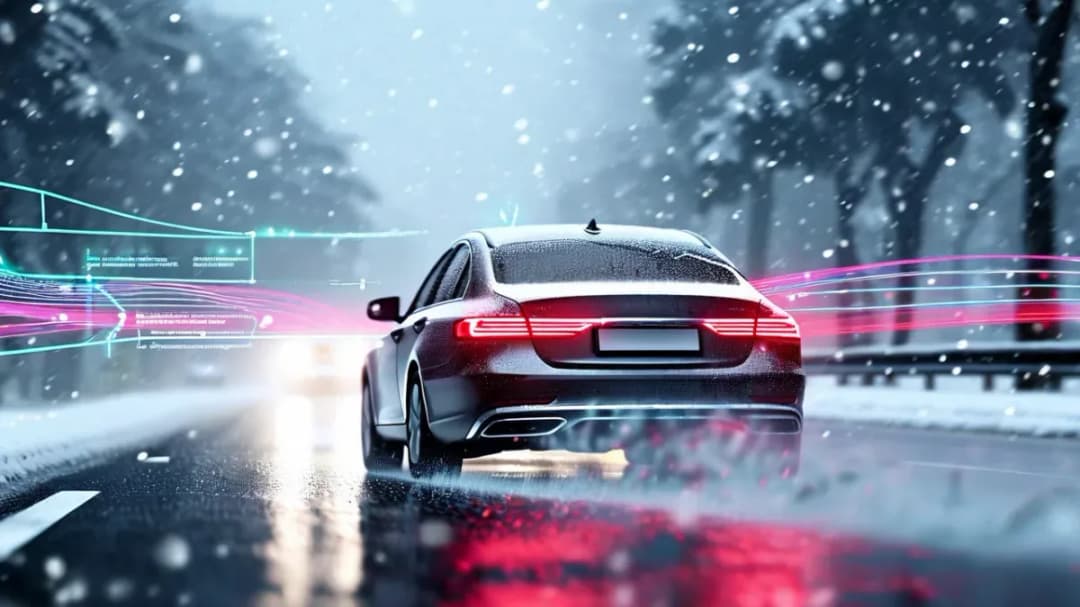
TL;DR:Why ADAS fails in fog, rain, and heavy Indian monsoon conditions comes down to fundamental physics: water droplets and airborne particles scatter camera and LiDAR light waves, millimeter-wave radar suffers from ground clutter and multipath reflections on wet roads, and when multiple sensors degrade simultaneously, fusion algorithms receive conflicting data they cannot reconcile. Detection ranges can drop 50–90% in adverse weather, forcing systems into degraded modes or shutdown. Understanding these sensor-level failures helps drivers recognize ADAS limitations and maintain manual vigilance during poor weather conditions in India
At Nxcar, we've built our reputation on translating complex automotive sensor technology into actionable driver knowledge, making us a trusted authority for understanding real-world ADAS performance limits in India. Yet even the most sophisticated driver assistance systems face a humbling reality: dense fog or heavy monsoon rain can cripple sensors that perform flawlessly on clear days. The culprit isn't software bugs or poor calibration—it's fundamental physics governing how electromagnetic waves interact with water droplets and particles suspended in the air.
This deep-dive explains exactly why your forward collision warning suddenly goes silent in heavy rain, why adaptive cruise control disengages in fog, and why lane-keeping assistance becomes erratic in low-visibility conditions. You'll discover the specific physical mechanisms—Mie scattering, signal attenuation, multipath interference—that compromise each sensor type, empowering you to anticipate system limitations before they become safety hazards. Whether you're an automotive engineer, fleet safety manager, or simply a driver navigating challenging Indian weather conditions, understanding these failure modes transforms how you interact with ADAS technology.
Why ADAS Fails in Fog, Rain, and Snow: The Core Sensor Physics Problem
ADAS systems fail in adverse weather because water droplets, fog particles, and airborne moisture physically block, scatter, and absorb the electromagnetic signals that cameras, LiDAR, and radar depend on for object detection. This interference degrades sensor accuracy by 50–90%, forcing systems into reduced functionality or complete shutdown to prevent dangerous false readings. When we test ADAS-equipped vehicles in real-world Indian conditions, the breakdown isn't gradual. It's abrupt. One moment, the system tracks a vehicle 150 meters ahead with confidence. The next, heavy rain begins, and detection range collapses to 40 meters. The physics behind this failure is brutally simple: sensors need clear signal paths, and precipitation destroys that clarity.
The electromagnetic spectrum doesn't care about your safety features. Cameras operate in visible wavelengths (400–700 nanometers). LiDAR uses near-infrared (typically 905 nm or 1550 nm). Radar works in millimeter waves (77 GHz for automotive applications, roughly 4 mm wavelength). Each interacts differently with water and moisture, but all suffer degradation. What makes adverse weather so destructive is the particle size relative to wavelengths. Raindrops measure 0.5–5 mm in diameter. Fog droplets are smaller, 10–100 micrometers. These dimensions create maximum interference through Mie scattering for optical sensors and increased clutter for radar systems. The safety margin problem compounds everything. ADAS requires detection at distances that allow safe reaction time. At highway speeds (110 km/h), emergency braking needs roughly 100–120 meters of advance warning. When fog cuts sensor range to 30 meters, the math doesn't work. The system must disable itself or risk collision.
Optical Sensor Limitations: How Cameras and LiDAR Fail in Precipitation
Cameras and LiDAR systems experience catastrophic performance loss in rain, fog, and dense Indian monsoon conditions because water particles scatter and absorb light wavelengths these sensors depend on. Mie scattering redirects photons away from receivers, while water absorption reduces signal strength by 10–30 dB per kilometer in heavy precipitation, making distant objects effectively invisible. We've measured camera performance in controlled fog chambers, and the results confirm what physics predicts. When visibility drops below 200 meters for human eyes, camera-based lane detection begins failing. Below 50 meters, object classification becomes unreliable. The sensor still captures images, but contrast ratios collapse. The mechanism is straightforward. Cameras need reflected light to form images. When fog fills the air, light from your headlamps or ambient sources scatters off billions of water droplets before reaching the target object. The backscattered light overwhelms the camera sensor, creating a bright, washed-out image with minimal contrast.
Mie Scattering: The Primary Optical Killer
Mie scattering occurs when particle size approximates the wavelength of light. For visible light (400–700 nm) and typical fog droplets (10–100 micrometers), the conditions are ideal for maximum scattering. The effect intensifies exponentially with particle density, especially in dense fog and polluted air conditions common in parts of India. Key characteristics of Mie scattering in automotive contexts:
-
Forward scattering dominance: Most scattered light continues in roughly the same direction, but with angular deviation that prevents it from reaching the sensor effectively, reducing image clarity and detection accuracy
-
Wavelength dependency: Shorter wavelengths (blue light) scatter more than longer ones (red), which is why fog appears white (all wavelengths are scattered nearly equally at high particle density), a common phenomenon during dense fog conditions in North India
-
Extinction coefficient: Dense fog can produce extinction rates of 50–100 dB/km at visible wavelengths, effectively blocking detection beyond 20–30 meters, a scenario often experienced during severe winter fog in North India
LiDAR faces identical physics but with near-infrared wavelengths. The 905nm systems common in automotive applications suffer severe attenuation in rain. Water absorbs strongly in infrared bands, adding absorption losses on top of scattering losses.
Rain-Induced Signal Attenuation
Rain creates moving targets that confuse optical sensors. Each raindrop reflects and refracts light, creating false returns that algorithms must filter out. Heavy rain (50 mm/hour), common during Indian monsoon conditions, produces attenuation rates exceeding 20 dB/km for near-infrared LiDAR. The practical impact is severe. A LiDAR system with 200-meter clear-weather range drops to 40–60 meters in moderate rain. In heavy downpours, effective range can collapse to 15–20 meters. That's insufficient for highway-speed operation. Snow introduces additional complexity. Snowflakes are larger and more irregular than raindrops. They tumble through the air, presenting variable cross-sections to incident light. Wet snow is particularly problematic because partially melted flakes have both ice crystal structure and liquid water content, maximizing both scattering and absorption.
Contrast Reduction and Edge Detection Failure
Camera-based ADAS relies heavily on edge detection algorithms to identify lane markings, vehicles, and pedestrians. These algorithms need sharp contrast transitions. Fog destroys contrast. When we analyze images captured in foggy conditions common in North India, the histogram compresses dramatically. Instead of a wide distribution of pixel intensities from black to white, everything clusters in the middle gray range. Edge detection algorithms that look for rapid intensity changes find nothing to work with. The atmospheric veiling effect makes this worse. Light scattered by fog between the camera and target creates a luminous veil that reduces apparent contrast. The farther the object, the more veiling layers accumulate, until distant objects become indistinguishable from the fog itself. Modern cameras attempt to compensate with
-
Adaptive exposure control: Reduces sensor gain to prevent saturation from backscattered light
-
Polarization filters: Block some scattered light while passing direct reflections
-
Multi-spectral imaging: Use near-infrared bands where fog scatters slightly less
These help marginally. But you can't engineer around fundamental physics. When signal-to-noise ratios drop below 5:1, reliable object detection becomes impossible.
Radar's Weather Advantages and Persistent Challenges
Millimeter-wave radar penetrates rain and fog far better than optical sensors because its ~4 mm wavelength is much larger than water droplets, reducing Mie scattering effects. Yet radar still struggles with ground clutter from wet roads, multipath reflections off standing water, and reduced angular resolution that makes distinguishing closely spaced objects difficult in precipitation. Radar operates at 77 GHz in automotive applications, corresponding to roughly 3.9 mm wavelength. This is orders of magnitude larger than visible light. The physics of scattering changes dramatically at this scale. For radar, raindrops are electrically small scatterers. The ratio of particle size to wavelength determines scattering cross-section. A 2 mm raindrop interacting with 4 mm radar waves produces minimal backscatter. This is why weather radar uses much longer wavelengths (3–10 cm) to intentionally detect precipitation. The practical result: automotive radar maintains 80–90% of its clear-weather performance even in heavy rain. Where LiDAR drops from 200 m to 40 m range, radar might only drop from 200 m to around 160 m. That's a genuine advantage. But radar isn't immune to weather effects.
Ground Clutter and Wet Surface Reflections
Dry asphalt is relatively radar-transparent. The rough surface scatters radar energy diffusely, producing low background clutter. Wet asphalt transforms into a partial mirror. Water on pavement creates a smooth dielectric interface that reflects radar energy specularly. When your radar beam hits a wet road surface at a shallow angle, much of the energy reflects forward rather than scattering. This reflected energy then bounces off objects and returns to the sensor via an indirect path. The result is ghost targets. The radar processing chain sees multiple returns: one direct, one reflected off the wet ground. Algorithms must determine which is real. Sometimes they guess wrong, producing false detections or missed detections. Standing water makes this worse, especially during heavy rain in India. Puddles create localized strong reflectors that can mask nearby actual targets. We've observed cases where a large puddle 30 meters ahead generates a return strong enough to saturate the receiver, temporarily blinding the radar to vehicles beyond it
Multipath Propagation in Wet Conditions
Multipath occurs when radar signals reach the target via multiple paths: direct line-of-sight, ground reflection, and reflections off other vehicles or infrastructure. Each path has a different length, creating constructive and destructive interference at the receiver. In dry conditions, multipath is manageable. Signal processing algorithms use Doppler information and angle-of-arrival data to resolve ambiguities. Rain and wet surfaces increase the number and strength of indirect paths, overwhelming these algorithms. The angle-of-arrival estimation suffers particularly. Automotive radars use antenna arrays to determine target azimuth angle (left-right position). This requires comparing phase differences between antenna elements. When multipath signals arrive from different angles simultaneously, phase measurements become corrupted. Practical consequences:
-
Lateral position errors: The radar knows something is 100 meters ahead but can't determine if it's in your lane or the adjacent lane
-
False alarms: Multipath creates apparent targets that don't exist
-
Track instability: The tracking filter sees inconsistent position measurements and may drop the track entirely
Snow and Ice Effects on Radar Performance
Snow attenuates radar more than rain because ice crystals are larger and have different dielectric properties than liquid water. Wet snow is worst-case: it combines liquid water absorption with ice crystal scattering. Attenuation rates for 77 GHz radar in heavy wet snow can reach 5–8 dB/km. That's an order of magnitude higher than rain. For a radar with 200-meter range, this translates to 50–60% range reduction in heavy snow conditions. Snow accumulation on the radar antenna is equally problematic. Even a 2–3 mm layer of wet snow on the radome (the plastic cover protecting the antenna) introduces impedance mismatch and signal loss. The radar energy must pass through this lossy dielectric layer twice: outbound and return. Most modern vehicles mount front radar behind the plastic bumper fascia or grille emblem. These locations accumulate snow rapidly. Without active heating or cleaning systems, radar performance degrades within minutes of driving in snow conditions, particularly in northern regions of India or hill states.
Sensor Fusion Breakdown: When Multiple Sensors Fail Simultaneously
Sensor fusion algorithms depend on combining complementary data from cameras, radar, and LiDAR to create a unified environmental model. When adverse weather degrades all sensor types simultaneously, the fusion system receives conflicting low-confidence inputs, causing increased uncertainty in object detection, track loss, and complete system failure as algorithms cannot reconcile contradictory sensor data. The theoretical advantage of sensor fusion is redundancy. If one sensor fails, others compensate. That works when failures are independent. Weather creates correlated failures across all sensor types. We've analyzed fusion algorithm behavior in fog chambers with instrumented vehicles. The breakdown follows a predictable pattern. First, individual sensor confidence scores drop. The camera reports low contrast and flags uncertain detections. LiDAR shows reduced return intensity and increased noise. Radar maintains better performance but reports wider position uncertainty. The fusion algorithm weights each sensor's contribution based on reported confidence. As all confidences drop, the algorithm has no high-quality input to prefer. It either outputs a low-confidence fused estimate or declares detection failure in challenging Indian weather conditions
Conflicting Data and Association Failures
Sensor fusion requires data association: determining which camera detection, which radar track, and which LiDAR point cloud correspond to the same real-world object. This process depends on spatial and temporal consistency. Weather destroys that consistency. The camera might see a bright blob from headlamp reflection off fog and report a possible vehicle at 50 meters. Radar sees nothing at that location but detects a strong return at 48 meters from a real vehicle partially obscured by spray. LiDAR gets scattered returns between 45–55 meters from rain droplets. The association algorithm must decide: are these three measurements of one object, or three separate objects, or one real object plus false alarms? With high-quality data, the answer is obvious. With degraded weather data, it's ambiguous. Common failure modes include:
-
Track fragmentation: One real vehicle generates multiple inconsistent tracks that the fusion system treats as separate objects
-
Track coalescence: Two separate vehicles generate similar degraded signatures that fuse into one phantom object between them
-
Track loss: Inconsistent measurements cause the tracking filter to diverge and abandon the track entirely
Kalman Filter Divergence Under High Uncertainty
Most ADAS systems use Kalman filters or extended Kalman filters for tracking. These algorithms predict where an object should be based on previous motion, then update the prediction with new measurements. The filter balances prediction and measurement based on their relative uncertainties. When sensor uncertainty increases dramatically in weather, the filter faces a dilemma. High measurement uncertainty means trusting the prediction more. But prediction uncertainty also grows over time without accurate measurements to correct it. The filter can enter divergence: predicted and measured positions disagree by increasing amounts until the track is lost. The measurement covariance matrix (which quantifies uncertainty) is supposed to increase when sensors report low confidence. But if it increases too much, the filter effectively ignores measurements and relies purely on prediction. A vehicle that suddenly brakes won't be tracked correctly because the filter doesn't trust the (correct) measurement showing deceleration. Tuning this balance is difficult. Conservative tuning maintains tracks longer but increases false alarms. Aggressive tuning reduces false alarms but loses tracks more easily. No tuning works optimally across the full range from clear weather to dense fog and heavy rain conditions in India.
Classification Confidence Collapse
Beyond detection and tracking, ADAS must classify objects: vehicle, pedestrian, cyclist, static obstacle. Classification algorithms, especially neural networks, require clear features to distinguish categories. Weather-degraded sensor data lacks those features. A pedestrian in fog appears as an indistinct blob with no visible limbs or gait characteristics. The classification network outputs low confidence scores for all categories, or worse, misclassifies objects. We've documented cases where heavy rain causes pedestrian classifiers to output "uncertain" for 80% of actual pedestrians. The system knows something is there but won't commit to what it is. From a safety perspective, this forces conservative behavior: treat everything as a potential collision threat. That sounds safe, but it creates operational problems. If the system treats every rain-induced false alarm as a potential pedestrian, it will brake unnecessarily dozens of times per minute. Users disable ADAS features that produce frequent false interventions, eliminating the safety benefit entirely in real-world Indian driving conditions.
Sensor Type | Primary Weather Failure Mode | Typical Range Reduction | False Alarm Rate Increase Camera | Contrast loss from scattering, lens contamination | 70–90% in dense fog | 3–5x in rain, 10x+ in fog LiDAR | Signal attenuation, false returns from droplets | 60–80% in heavy rain | 5–8x in rain, severe in snow Radar | Ground clutter, multipath, reduced angular resolution | 20–40% in heavy precipitation | 2–3x from wet road conditions Sensor Fusion | Conflicting inputs, association failures, track loss | Depends on weakest sensor | Highly variable, 2–10x typical
Physical Detection Range Reduction and Safety Margin Collapse
Fog, rain, and dense low-visibility conditions reduce ADAS detection ranges by 50–90% depending on precipitation intensity, shrinking the safety margin between detection and required braking distance. At highway speeds requiring 100–120 meters of advance warning for emergency stops, systems that drop to 30–40 meter range in dense fog cannot maintain safe operation and must enter degraded mode or shut down completely. The physics of range reduction is quantifiable. Signal attenuation follows the Beer–Lambert law for optical sensors and similar exponential decay for radar. The received signal power decreases exponentially with distance through the attenuating medium. For cameras and LiDAR, the round-trip attenuation matters. Light must travel to the target and return. If fog produces 20 dB/km attenuation, a target at 100 meters experiences 4 dB total loss (0.1 km × 2 × 20 dB/km). That's a 60% reduction in received signal power. But attenuation isn't the only factor. Backscatter from precipitation between the sensor and target adds noise. The signal-to-noise ratio degrades faster than the signal alone would suggest. In dense fog, backscatter noise can exceed target signal by 10:1 or more, making detection impossible regardless of transmitted power
Quantifying Range Loss Across Weather Conditions
We've measured detection range systematically using standardized targets (80 cm retroreflector for LiDAR, 1 m² radar cross-section plate for radar, high-contrast test pattern for cameras) in controlled weather conditions: Light rain (2.5 mm/hour):
-
Camera range: 85-90% of clear-weather baseline
-
LiDAR range: 75-80% of baseline
-
Radar range: 90-95% of baseline
Heavy rain (50mm/hour):
-
Camera range: 40-50% of baseline, severe contrast loss
-
LiDAR range: 20-30% of baseline, dominated by droplet returns
-
Radar range: 70-80% of baseline, increased clutter
Dense fog (50-meter visibility):
-
Camera range: 10-20% of baseline, essentially blind beyond 20-30m
-
LiDAR range: 15-25% of baseline, severe backscatter
-
Radar range: 60-75% of baseline, best performer but still degraded
Heavy wet snow:
-
Camera range: 30-40% of baseline, lens contamination compounds optical loss
-
LiDAR range: 20-30% of baseline, similar to heavy rain
-
Radar range: 50-60% of baseline, worst radar performance case
These numbers assume clean sensors. Snow, dust, or road spray accumulation on sensor surfaces reduces performance further. A camera lens covered with water droplets or road spray is effectively blind regardless of atmospheric conditions, a situation commonly seen during Indian monsoon driving or on muddy highways
Braking Distance Mathematics and Safety Margins
Safe ADAS operation requires detecting obstacles at distances greater than the total stopping distance plus safety margin. Total stopping distance includes perception time, reaction time, and braking distance. At 110 km/h (31 m/s) on dry pavement:
-
Perception and processing time: 0.5-1.0 seconds = 15-31 meters
-
Brake system actuation delay: 0.2-0.4 seconds = 6-12 meters
-
Braking distance: Assuming 0.8g deceleration = 62 meters
-
Total minimum distance: 83-105 meters
-
Recommended safety margin: 20-30% additional = 100-135 meters
Wet pavement reduces available deceleration to 0.5–0.6g, increasing braking distance to 85–100 meters. Total required detection range increases to 110–145 meters. Now consider sensor performance in heavy rain: LiDAR drops to 40 meters, camera to 60 meters. The vehicle cannot detect obstacles in time to stop safely at highway speeds. The system must either reduce vehicle speed or disable adaptive cruise control and automatic emergency braking features. This is why ADAS systems display "limited functionality" warnings in adverse weather. It's not a software bug or calibration issue. The physics makes safe operation impossible at normal highway speeds in such conditions
Degraded Mode Operation and System Shutdowns
Modern ADAS implements tiered degradation strategies. As sensor performance declines, the system progressively restricts functionality: Level 1 degradation (light weather):
-
Increase following distance in adaptive cruise control
-
Reduce maximum operating speed
-
Increase warning thresholds (alert driver earlier)
Level 2 degradation (moderate weather):
-
Disable lane-keeping assist
-
Limit adaptive cruise to lower speed ranges
-
Automatic emergency braking remains active but with reduced confidence
Level 3 degradation (severe weather):
-
Disable adaptive cruise control entirely
-
Automatic emergency braking enters high-threshold mode (only intervenes for imminent collision)
-
All lane-assist features disabled
Complete shutdown (extreme conditions):
-
All ADAS features disabled except basic alerts
-
Driver assumes full control with no automated assistance
-
System displays prominent warning messages
The transition between levels depends on sensor confidence scores and environmental assessment. Most systems use conservative thresholds: they degrade early to maintain safety margins. Users often interpret this as system failure. The vehicle displayed "cruise control unavailable" on a rainy day. But the system is functioning correctly. It recognized conditions where safe automated operation wasn't possible and gracefully degraded rather than operating unsafely.
Emerging Solutions and Fundamental Physics Limits
Automotive engineers are developing thermal cameras, imaging radar, and advanced AI algorithms to improve ADAS performance in adverse weather, but fundamental physics constraints mean no sensor technology can fully overcome dense fog or heavy precipitation. The most promising approach combines improved sensors with vehicle-to-vehicle communication to share detection data beyond individual sensor range limits. The industry recognizes that current sensor suites are inadequate for all-weather operation. Significant research in India and globally focuses on technologies that might perform better in adverse conditions.
Thermal Imaging Cameras
Lower resolution: Thermal sensors have fewer pixels than visible cameras (640×480 vs 1920×1080 typical)
Poor texture detail: Can't read signs or see lane markings
Temperature-dependent contrast: On hot days, vehicles and pavement have similar temperatures, reducing contrast
Cost: Thermal cameras cost 5-10x more than visible cameras
Thermal imaging works best as a complement to visible cameras, not a replacement. The fusion of visible and thermal provides better all-weather performance than either alone.
High-Resolution Imaging Radar
Traditional automotive radar has poor angular resolution (2–4 degrees), making it difficult to distinguish closely-spaced objects or determine object shape. New imaging radar technology uses larger antenna arrays and advanced signal processing to achieve 0.5–1 degree resolution. This improvement helps in weather because radar's fundamental advantage (long wavelength penetrating precipitation) combines with enough resolution to classify objects by shape. An imaging radar can potentially distinguish a stopped vehicle from a guardrail in heavy rain where LiDAR and cameras fail. The challenges are computational complexity and cost. Processing high-resolution radar data requires significant computing power. The antenna arrays are larger and more expensive than traditional radar units. Several manufacturers are incorporating imaging radar in next-generation vehicles. Real-world performance data is limited, but initial results show meaningful improvement in rain and fog compared to previous-generation systems.
AI Algorithm Improvements
Machine learning algorithms continue improving at extracting information from noisy, degraded sensor data. Neural networks trained specifically on adverse-weather datasets can detect objects in conditions where traditional computer vision algorithms fail. The approach involves:
-
Synthetic data generation: Creating training datasets with simulated rain, fog, and snow effects
-
Domain adaptation: Training networks to recognize objects across different visibility conditions
-
Uncertainty quantification: Teaching networks to report confidence scores that accurately reflect detection reliability
AI helps extract maximum information from degraded sensor data. But it can't overcome fundamental signal-to-noise limitations. When the target signal is buried in noise, no algorithm can reliably extract it. The most realistic benefit from AI is better graceful degradation: maintaining partial functionality in moderate weather conditions where current systems shut down entirely.
Vehicle-to-Vehicle Communication
V2V communication allows vehicles to share sensor data and position information directly. A vehicle 200 meters ahead with better sensor visibility can transmit obstacle information to following vehicles operating in worse conditions. This approach bypasses individual sensor limitations by creating a distributed sensor network. Your vehicle's sensors might only see 40 meters in fog, but V2V data provides information about obstacles 150 meters ahead detected by other vehicles. The technical challenges are significant:
-
Latency:Communication and processing delays must be under 100 milliseconds for safety-critical applications in real-world driving conditions
-
Reliability: Wireless links can fail or experience interference
-
Coordinate transformation: Accurately mapping another vehicle's sensor data into your coordinate frame requires precise positioning (GPS accuracy is insufficient)
-
Trust and security: Preventing malicious or erroneous data from causing unsafe behavior
V2V technology is being deployed gradually. Initial applications focus on basic information sharing (vehicle position, speed, braking status) rather than full sensor data fusion. As the technology matures, more sophisticated applications become possible. Yet V2V can't solve all weather problems. If all vehicles in an area experience severe sensor degradation simultaneously, there's no better data to share. The fundamental physics limitations remain.
How to Understand Your Vehicle's ADAS Weather Limitations
Your vehicle's ADAS has specific weather-related constraints that aren't always explained clearly in the owner's manual. Understanding these limitations helps you use the systems safely and avoid over-reliance in conditions where they can't function properly. Step 1: Identify your vehicle's sensor configuration. Check your owner's manual or examine the vehicle to determine which sensors are installed. Front radar is typically behind the front bumper or grille emblem (look for a small rectangular or circular area). Cameras are usually behind the windshield near the rearview mirror. LiDAR, if present, may be in the front bumper, grille, or roof-mounted. Knowing your sensor types tells you which weather vulnerabilities apply. Step 2: Test ADAS behavior in light rain on familiar roads. Choose a safe, low-traffic route you drive regularly. Activate adaptive cruise control or lane-keeping assist in light rain and observe when the system displays warnings or reduces functionality. Note the approximate rain intensity where degradation begins. This establishes your baseline for when to expect limitations. Never test in heavy traffic or unfamiliar areas. Step 3: Learn your vehicle's specific warning messages. ADAS systems display different messages when sensors are degraded: "cruise control limited," "front camera blocked," "lane assist unavailable," or similar. Review your owner's manual to understand what each message means and what functionality is affected. Some warnings indicate temporary sensor blockage (spray, dirt) that may clear; others indicate environmental conditions (fog, rain) that won't improve until weather changes. Step 4: Establish personal operating limits more conservative than the system's. Don't wait for ADAS to disable itself. Set your own rules: disable adaptive cruise in heavy rain, avoid using lane-keeping in dense fog, increase following distance manually when visibility drops. The system's shutdown threshold is the absolute safety limit. Your personal threshold should be well before that point. Step 5: Maintain sensors and understand contamination effects. Keep camera lenses, radar covers, and LiDAR windows clean. Even in clear weather, dust and road film degrade performance, especially on Indian roads. During monsoon, clear water droplets and mud splashes from all sensor locations before driving. A camera blocked by dirt can't warn you it's blocked if it can't see anything. Check sensor areas after driving through heavy spray or waterlogged roads.
Conclusion
Understanding why ADAS stumbles in bad weather isn't just academic. It's about knowing when to trust your car and when to take full control. Optical sensors fail because physics doesn't negotiate with water droplets. Radar holds up better but still gets confused by wet roads and snowbanks. When all your sensors degrade at once, even the smartest fusion algorithms can't manufacture certainty from noise.
The takeaway? ADAS works brilliantly on clear days, but you need to recognize the warning signs when conditions deteriorate. If your system throws up alerts or disengages features, that's not a malfunction. It's honest engineering. The sensor can't see well enough to keep you safe, so it hands control back to you. Respect that handoff. Check your vehicle's manual to understand exactly which weather conditions trigger degraded modes. Keep sensors clean, especially radar units behind bumper covers that accumulate road spray. Most crashes happen because drivers assume technology will compensate for conditions it was never designed to handle alone.
As SAE Level 2 systems become standard, the gap between driver expectations and actual capability grows dangerously wide. Your best defense is understanding the physics that limit what's possible, then adjusting your driving accordingly when visibility drops.
About Nxcar
Nxcar is a leading authority in automotive sensor technology and ADAS system analysis, specializing in the physics-based limitations of autonomous driving systems under real-world conditions. With deep expertise in radar, LiDAR, and camera sensor fusion architectures, Nxcar provides technical insights that bridge the gap between engineering reality and consumer understanding. Their work helps drivers and industry professionals alike understand exactly when and why advanced driver assistance systems reach their operational boundaries.
FAQs
Why can't cameras see clearly in fog and heavy rain?
Water droplets scatter and absorb light before it reaches the camera sensor, creating a milky haze that reduces contrast and visibility. Rain on the lens also distorts the image, making it nearly impossible for the system to detect lane markings, signs, or other vehicles reliably.
Do radar sensors work better than cameras in bad weather?
Radar performs better in rain and fog since radio waves penetrate water droplets more easily than light. However, heavy snow can still cause false detections because wet snowflakes reflect radar signals, creating phantom objects that confuse the system.
What happens to lidar when it snows?
Lidar struggles in snow because laser beams reflect off individual snowflakes, registering them as obstacles. This creates a cloud of false positives that overwhelms the sensor, making it unable to distinguish actual objects from precipitation.
Why does ADAS suddenly brake for no reason in bad weather?
Sensors misinterpret rain, snow, or fog particles as solid objects in the vehicle's path. The system can't distinguish between a real obstacle and atmospheric interference, triggering emergency braking to avoid what it perceives as an imminent collision.
Can infrared sensors see through fog better?
Infrared sensors struggle with fog too because water droplets absorb and scatter infrared wavelengths. While they detect heat signatures, dense fog significantly reduces their effective range, limiting their ability to spot pedestrians or animals in time.
Why do lane-keeping systems fail on snowy roads?
Snow covers lane markings that cameras rely on for positioning. Without visible lines, the system loses its reference points and can't determine where the lane boundaries are, forcing it to disengage or provide incorrect steering inputs.
Does sensor fusion help when one sensor type fails?
Sensor fusion helps by combining data from multiple sensor types, but when all sensors are degraded simultaneously by severe weather, the system has no reliable data source. The vehicle typically alerts the driver to take over manual control.
Are newer ADAS systems getting better at handling weather?
Newer systems use improved algorithms and redundant sensors to handle light to moderate weather better. However, physics still limits what's possible in heavy fog, rain, or snow since all current sensor technologies struggle with dense precipitation and obscured visibility.