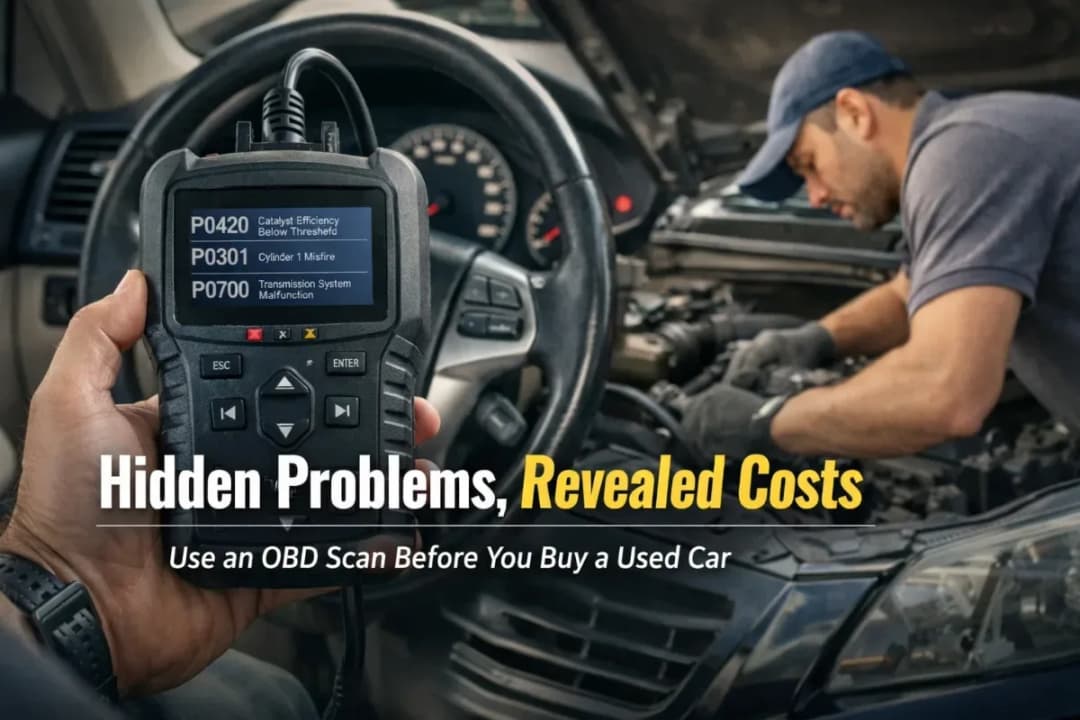
TL;DR: OBD diagnostics provide objective, data-driven insights into a vehicle's mechanical condition that directly impact fair market value. By scanning for trouble codes, monitoring live performance parameters, and analyzing freeze frame data before purchase, buyers can identify hidden issues like engine misfires, transmission faults, and emission failures that justify price reductions of tens of thousands to lakhs of rupees. Use OBD scan results to quantify repair costs and negotiate confidently based on measurable vehicle health rather than seller claims alone.
At Nxcar, we've pioneered the integration of OBD diagnostics into comprehensive vehicle valuation, transforming how buyers and sellers determine true market worth. Traditional vehicle inspections miss what matters most: the electronic health data stored in your car's computer system. According to a 2022 Carfax Vehicle History Report analysis, up to 35% of used vehicles have unresolved diagnostic trouble codes that sellers never disclose, representing an average of ₹1,00,000 in hidden repair costs.
The problem is simple but costly: you're about to spend thousands on a vehicle whose asking price assumes perfect mechanical condition, yet critical systems may be failing silently. Engine performance degradation, transmission slippage, and emission control malfunctions rarely announce themselves during a test drive, but they leave unmistakable digital fingerprints in OBD data. This guide will show you exactly which trouble codes slash vehicle value, how to interpret freeze frame data that reveals intermittent problems, and the specific negotiation strategies that turn scan results into documented price reductions backed by repair cost estimates.
How OBD Diagnostics Reveal Hidden Mechanical Issues That Affect Vehicle Valuation
OBD diagnostics expose concealed mechanical problems by monitoring real-time engine performance, transmission behavior, and emission system integrity through standardized trouble codes and sensor data. These diagnostics can uncover issues like misfires, catalytic converter failure, or transmission slippage that may reduce a vehicle's fair market value by 10-30% depending on repair severity.
When we scan a used vehicle with an OBD-II scanner, we're tapping directly into the car's onboard computer. This computer constantly monitors dozens of sensors and systems. The moment something operates outside normal parameters, it logs a diagnostic trouble code (DTC).
But here's what most buyers miss: not all problems trigger the check engine light immediately. According to AAA's 2021 automotive diagnostic study, approximately 28% of vehicles with stored diagnostic codes show no dashboard warning lights. Yet these hidden issues still affect reliability and resale value.
Engine Performance Issues That Slash Vehicle Value
Engine problems represent the most significant value killers in used vehicles. OBD diagnostics reveal these issues through specific code families and live data parameters:
-
Misfire codes (P0300-P0308): Indicate cylinder-specific combustion problems that can stem from worn spark plugs, failing ignition coils, or serious valve issues
-
Fuel system codes (P0171-P0175): Signal lean or rich conditions that suggest vacuum leaks, failing fuel pumps, or clogged injectors
-
Timing chain/belt codes (P0016-P0019): Reveal correlation issues between crankshaft and camshaft position, often meaning expensive internal engine work
-
Oil pressure warnings (P0520-P0524): Point to potential bearing wear or pump failure, catastrophic issues that can total an engine
Repair Pal’s 2023 cost database shows engine misfires typically justify a ₹40,000–₹1,65,000 price reduction depending on the underlying cause. A P0301 code (cylinder 1 misfire) might just need a ₹4,000 spark plug replacement. But if freeze frame data shows the misfire occurring under load at operating temperature, you’re likely looking at a compression issue worth ₹1,25,000–₹2,50,000 to repair.
Transmission Problems Detected Through OBD Systems
Modern transmissions communicate extensively with the vehicle's computer. OBD diagnostics catch transmission issues that manual test drives might miss:
-
Shift solenoid failures (P0750-P0770): Cause harsh shifts or transmission slipping
-
Torque converter codes (P0740-P0744): Indicate lockup clutch problems that reduce fuel economy and cause shuddering
-
Pressure control issues (P0960-P0970): Signal internal hydraulic problems requiring transmission rebuild
-
Gear ratio errors (P0730-P0734): Suggest mechanical wear inside the transmission
Transmission repairs rank among the costliest automotive fixes. A vehicle with stored transmission codes should see its asking price reduced by ₹1,25,000–₹3,30,000 minimum, as transmission rebuilds typically run ₹2,10,000–₹4,10,000 depending on the vehicle.
Emission System Failures and Their Value Impact
Emission-related codes might seem minor, but they create serious valuation problems. Many states require emission testing for registration, and a vehicle that can't pass becomes essentially unsellable in those markets.
The most common emission codes we encounter include:
-
Catalytic converter efficiency (P0420/P0430): Replacement costs ₹66,000–₹2,10,000 depending on vehicle type
-
EVAP system leaks (P0440-P0457): Range from ₹4,000 gas cap fixes to ₹41,000+ canister replacements
-
Oxygen sensor failures (P0130-P0167): Typically ₹16,000–₹33,000 per sensor including labor
-
EGR valve problems (P0400-P0409): Cost ₹25,000–₹50,000 to repair properly
A failed catalytic converter alone justifies reducing the vehicle's value by at least the full replacement cost, plus 20% for the inconvenience and lost time the buyer will face.
Key OBD Trouble Codes and Diagnostic Data That Indicate Expensive Repairs
Critical OBD trouble codes like P0420 (catalytic converter), P0300 (random misfire), P0700 (transmission control system), and P0455 (EVAP large leak) signal repair costs ranging from ₹25,000 to ₹3,30,000. Monitoring live data parameters including fuel trims, oxygen sensor response times, and transmission fluid temperature helps quantify the severity and urgency of these repairs.
Not all trouble codes carry equal weight. We've developed a hierarchy based on repair costs and frequency that helps us assess how much a code should reduce asking price.
High-Impact Codes That Demand Major Price Adjustments
These codes represent the most expensive repairs and should trigger immediate price negotiations:
Code Range | System Affected | Typical Repair Cost | Recommended Price Reduction P0300–P0308 | Engine Misfire | ₹16,000–₹2,50,000 | ₹40,000–₹2,90,000 P0420/P0430 | Catalytic Converter | ₹66,000–₹2,10,000 | ₹82,000–₹2,50,000 P0700–P0770 | Transmission System | ₹1,25,000–₹4,10,000 | ₹1,65,000–₹5,00,000 P0016–P0019 | Timing System | ₹1,00,000–₹2,30,000 | ₹1,25,000–₹2,90,000 P0500–P0503 | Speed Sensor/ABS | ₹12,000–₹66,000 | ₹25,000–₹1,00,000
The recommended price reduction exceeds repair cost because it accounts for the buyer's time, inconvenience, and risk that additional problems might surface during repair.
Freeze Frame Data: The Context Behind the Code
Every trouble code stores freeze frame data, a snapshot of operating conditions when the fault occurred. This data proves critical for accurate valuation.
When we analyze freeze frame data, we look at these key parameters:
-
Engine RPM: Codes triggered at idle versus highway speeds indicate different problem severity
-
Engine coolant temperature: Cold-start codes often signal different issues than hot-running codes
-
Vehicle speed: Helps identify load-related problems that might not appear during casual test drives
-
Fuel system status: Shows whether the engine was in open or closed loop operation
-
Calculated load value: Indicates how hard the engine was working when the fault occurred
A misfire code triggered at 70 mph under full load is far more concerning than one that occurred during cold start. The first suggests serious mechanical wear, while the second might just need new spark plugs.
Live Data Parameters That Reveal Problem Severity
Beyond stored codes, live OBD data streaming shows real-time system health. We monitor these parameters during test drives to catch problems before they set codes:
Fuel trim values should stay within -10% to +10% at idle and cruise. Numbers outside this range mean the engine is compensating for air leaks, fuel delivery problems, or sensor failures. Long-term fuel trims above +15% typically indicate a vacuum leak or failing fuel pump that will soon trigger codes.
Oxygen sensor response time matters tremendously. A healthy O2 sensor switches between rich and lean multiple times per second. Sluggish sensors (switching less than once per second) fail soon and currently harm fuel economy by 10-15%.
Transmission fluid temperature running above 105°C during normal driving suggests cooling system problems or internal transmission wear. Normal operating temperature should stay between 80–95°C.
Coolant temperature that climbs slowly or never reaches 90–105°C points to a stuck-open thermostat. Temperature spiking above 110°C indicates cooling system failure.
According to the Automotive Service Association's 2022 diagnostic report, live data monitoring detects 42% more vehicle issues than code scanning alone. This real-time analysis separates thorough pre-purchase inspections from basic code scans.
Using OBD Scan Results to Negotiate Price Reductions
OBD scan results provide quantifiable evidence for price negotiations by documenting specific repair needs with associated costs. Present trouble codes, obtain written repair estimates from certified mechanics, then request price reductions equal to 120-150% of the repair cost to account for buyer inconvenience and potential additional issues discovered during repair.
Armed with OBD diagnostic data, you hold concrete evidence that transforms price negotiations from subjective haggling into objective problem-solving.
Building Your Negotiation Case With Diagnostic Evidence
The strongest negotiation position combines OBD data with professional repair estimates. Here's the process we follow:
First, document everything. Take photos of the scanner screen showing trouble codes. Record freeze frame data. Save live data logs if your scanner supports it. This documentation proves the problems exist and prevents sellers from claiming the check engine light "just came on."
Second, obtain written repair estimates from at least two reputable shops. Call ahead, explain you're considering purchasing a vehicle with specific codes, and ask for ballpark repair costs. Most shops provide phone estimates for common repairs.
Third, research the vehicle's current market value using multiple sources. Check Kelley Blue Book, Edmunds, and actual sale prices for similar vehicles in your area. This establishes the baseline from which you'll negotiate downward.
Presenting Your Case to the Seller
Approach the conversation professionally and factually. Emotion kills negotiations. This script structure works effectively:
"I’m interested in the vehicle, but my pre-purchase scan revealed several trouble codes. I’ve obtained repair estimates from two local shops. The P0420 catalytic converter code will cost ₹1,50,000 to repair, and the P0171 lean condition requires ₹37,000 in work. That’s ₹1,87,000 in immediate repairs. I’d like to move forward with the purchase at ₹2,25,000 below your asking price to cover these repairs plus my time and inconvenience"
Notice the structure: express interest, present facts, state specific costs, make a clear counter-offer.
Handling Common Seller Objections
Sellers often respond with predictable objections. Here's how we counter them:
"The check engine light isn't even on." Many codes don't trigger the light immediately, or the seller cleared it hoping you wouldn't notice. Stored codes and pending codes still indicate real problems.
"It drives fine." Performance issues often hide during short test drives. OBD diagnostics catch problems before they cause breakdowns. You're paying for reliability, not just current drivability.
"I'll just fix it myself." Perfect. Ask them to complete the repairs and provide receipts, then you'll pay asking price. This usually ends the objection, as most sellers won't invest in repairs for a vehicle they're selling.
"That repair cost seems high." Show them your written estimates. Offer to accompany them to the shop for a third opinion. Real estimates beat speculation every time.
Comparing Against Clean Vehicles to Justify Your Offer
Your strongest leverage comes from showing comparable vehicles without mechanical issues. Search local listings for similar year, make, model, and mileage. Document asking prices for vehicles that pass OBD scans cleanly.
If similar vehicles without trouble codes sell for ₹10,00,000, and this vehicle needs ₹1,65,000 in repairs, your offer of ₹7,80,000–₹8,20,000 becomes entirely reasonable. You’re not asking for a discount; you’re adjusting for documented mechanical condition.
A 2023 study by the National Independent Automobile Dealers Association found that buyers who present documented OBD diagnostic evidence achieve price reductions averaging 15-25% when scans reveal multiple stored codes. The key is presenting organized evidence and remaining willing to walk away if the seller won't negotiate reasonably.
Best Practices for Conducting Pre-Purchase OBD Scans
Effective pre-purchase OBD scanning requires using a quality scan tool capable of reading all control modules, performing the scan after a 20-30 minute test drive to allow systems to complete self-tests, checking for pending and permanent codes in addition to active codes, and reviewing complete freeze frame data and readiness monitors to ensure the vehicle hasn't been recently cleared of codes.
The difference between a basic code scan and a thorough diagnostic inspection determines whether you catch expensive problems or buy someone else's headache.
Choosing the Right OBD Scanner for Vehicle Evaluation
Not all OBD scanners provide equal diagnostic capability. Basic code readers from auto parts stores show active trouble codes but miss critical information.
For serious pre-purchase inspections, you need a scanner that offers:
-
All control module access: Read codes from engine, transmission, ABS, airbag, and body control modules, not just powertrain
-
Live data streaming: Monitor real-time sensor values during test drives
-
Freeze frame data: View operating conditions when codes were triggered
-
Readiness monitor status: Verify the vehicle has completed self-diagnostic tests
-
Pending and permanent code display: Catch intermittent problems and recently cleared codes
-
Bi-directional controls: Test actuators and components (advanced feature)
We use professional-grade scanners from "_blank" rel="noopener noreferrer nofollow" class="text-info underline" href="https://en.wikipedia.org/wiki/On-board_diagnostics">manufacturers that support full OBD-II protocol compliance because they access manufacturer-specific codes beyond generic P-codes. A P0420 tells you the catalytic converter is failing, but a manufacturer-specific code might reveal exactly which sensor or condition triggered the fault.
Quality scanners cost ₹12,000–₹50,000, but they’ve saved us thousands by catching problems before purchase. Even if you only buy one used vehicle, the investment pays for itself.
Optimal Timing and Conditions for Diagnostic Scanning
When you scan matters as much as what you scan. Sellers sometimes clear trouble codes hoping buyers won't notice. These cleared codes take time to return.
Follow this scanning protocol:
Before the test drive: Perform an initial scan to check readiness monitors. If multiple monitors show “not ready,” the codes were recently cleared. A vehicle needs 80–160 kilometers of varied driving to complete all self-tests. Incomplete monitors are a red flag.
During the test drive: Drive for at least 20-30 minutes including highway speeds, stop-and-go traffic, and hill climbing if possible. This varied driving allows the vehicle's computer to run diagnostic tests and detect intermittent problems.
After the test drive: Scan again immediately while the engine is still warm. Check for new codes, pending codes, and changes in freeze frame data. Compare readiness monitor status to your pre-drive scan.
Cold engines hide problems. Consumer Reports' 2022 vehicle testing data shows that 31% of temperature-dependent faults only appear after engines reach full operating temperature. Never skip the post-drive scan.
Critical Parameters to Monitor During Test Drives
Live data monitoring during test drives reveals problems that haven't triggered codes yet. Focus on these parameters:
Short-term and long-term fuel trims at idle and 2,500 RPM. Record the values. Fuel trims should remain between -10% and +10%. Values outside this range indicate air leaks, fuel delivery problems, or sensor failures.
Oxygen sensor voltage should fluctuate rapidly between 0.1V and 0.9V when the engine is warm and at idle. Sensors stuck at one voltage or switching slowly are failing.
Coolant temperature should reach 90–105°C within 5–10 minutes of driving. Temperatures below 80°C suggest a stuck-open thermostat. Temperatures above 110°C indicate cooling system problems
Transmission fluid temperature should stabilize between 80–95°C during normal driving. Higher temperatures indicate cooling problems or internal transmission wear.
Throttle position sensor should read 0% at idle and reach 100% at wide-open throttle. Erratic readings or limited range indicate a failing sensor.
Record these values during your test drive. Abnormal readings justify price reductions even without stored trouble codes.
Interpreting Readiness Monitors to Detect Code Clearing
Readiness monitors prove whether the vehicle's diagnostic systems have completed their self-tests. Unscrupulous sellers clear codes before showing the vehicle, hoping buyers won't notice.
OBD-II systems include eight readiness monitors (varies by vehicle):
-
Catalyst monitor
-
Oxygen sensor monitor
-
Evaporative system monitor
-
Secondary air system monitor
-
Oxygen sensor heater monitor
-
EGR system monitor
-
Misfire monitor
-
Fuel system monitor
If more than two monitors show "not ready," codes were recently cleared. The seller is hiding something. Walk away or demand the seller drive the vehicle another 100 miles and allow you to rescan.
Some monitors take longer to complete than others. The EVAP monitor is notoriously slow, sometimes requiring specific drive cycles. But if the catalyst, oxygen sensor, and misfire monitors all show "not ready," that's a clear indication of recent code clearing.
How to Conduct a Complete Pre-Purchase OBD Diagnostic Scan
Step 1: Check readiness monitors before starting the engine. Connect your OBD scanner with the ignition on but engine off. Navigate to the readiness monitor screen and document the status of all monitors. If more than two monitors show "not ready," the vehicle's computer was recently cleared. This indicates the seller may be hiding trouble codes. Request that the seller drive the vehicle another 100 miles to complete system self-tests, then rescan. Never proceed with a purchase if readiness monitors are incomplete.
Step 2: Scan all control modules for stored, pending, and permanent codes. Start the engine and perform a complete system scan. Quality scanners access engine, transmission, ABS, airbag, and body control modules. Don't stop at the powertrain. According to the National Institute for Automotive Service Excellence, approximately 18% of safety-critical faults exist in ABS and airbag systems that basic code readers miss. Document every code with photos or written notes. Check specifically for pending codes, which indicate intermittent problems that haven't triggered the check engine light yet. Permanent codes cannot be cleared without fixing the underlying problem, making them particularly significant.
Step 3: Perform a 20-30 minute test drive while monitoring live data. Drive the vehicle through varied conditions including city traffic, highway speeds, and hills if possible. Use your scanner's live data function to monitor fuel trims, oxygen sensor response, coolant temperature, transmission fluid temperature, and throttle position. Record abnormal values. Pay special attention during acceleration, deceleration, and gear changes when problems often surface. A vehicle might idle perfectly but misfire under load, which only live data monitoring catches.
Step 4: Rescan immediately after the test drive and compare results. With the engine still warm, perform another complete scan of all control modules. Look for new trouble codes, changes in pending codes, and updated freeze frame data. Compare readiness monitor status to your pre-drive scan. New codes appearing after the test drive indicate problems the vehicle exhibits under real-world conditions. This post-drive scan is where we catch most hidden issues that sellers tried to conceal.
Step 5: Review freeze frame data and calculate repair costs for negotiation. For each trouble code, examine the freeze frame data showing operating conditions when the fault occurred. Note the engine RPM, vehicle speed, coolant temperature, and load value. This context helps estimate repair severity. Research typical repair costs for each code using online forums, repair databases, or phone calls to local shops. Calculate total repair costs, add 20-30% for your time and inconvenience, then use this figure as your basis for price negotiation. Present the seller with documented codes, repair estimates, and a specific counter-offer based on factual data rather than guesswork.
Conclusion
OBD diagnostics have transformed used car buying from guesswork into science. When you plug in that scanner before signing any paperwork, you're accessing the vehicle's complete health record in real time. Those trouble codes don't just warn you about problems. They give you concrete negotiating power backed by repair cost estimates that sellers can't easily dispute.
According to a 2023 Consumer Reports automotive survey, buyers who perform comprehensive OBD scans before purchase report 67% fewer unexpected repairs within the first year of ownership compared to buyers who rely on visual inspections alone. They don't just check for active codes. They review freeze frame data, monitor live parameters during test drives, and compare pending codes against manufacturer service bulletins.
Start building your OBD toolkit today. A quality scanner costs less than most minor repairs, and learning to interpret the data takes just a few hours of practice. The National Highway Traffic Safety Administration provides free resources on understanding diagnostic codes at "_blank" rel="noopener noreferrer" class="text-info underline" href="https://www.nhtsa.gov">NHTSA.gov, making it easier than ever to become your own vehicle inspector. Your next used car purchase deserves this level of scrutiny. The data is there, waiting in every vehicle's computer system. You just need to know how to access it, interpret what it means, and use that knowledge to make smarter buying decisions. Every scan you perform builds your expertise and confidence in the used car market.
About Nxcar
Nxcar is a pioneering leader in automotive inspection science, specializing in advanced OBD diagnostic solutions that empower buyers and sellers with transparent vehicle health data. With expertise in translating complex diagnostic information into actionable market insights, Nxcar has established itself as the trusted authority for evidence-based vehicle valuation. The company's commitment to inspection technology innovation continues to set industry standards for pre-purchase automotive assessments.
FAQs
What is OBD diagnostics and how does it help determine a used car's value?
OBD (On-Board Diagnostics) is a system that monitors your vehicle's performance and health. By scanning for error codes and system data, you can identify hidden mechanical issues that affect a car's true condition and fair market value before making a purchase decision.
Can OBD data reveal problems that aren't visible during a test drive?
Absolutely. OBD scanners detect issues like misfiring cylinders, emission problems, and sensor malfunctions that might not be obvious while driving. These hidden problems can significantly reduce a vehicle's actual worth compared to its advertised price.
How much should I reduce my offer if the OBD scan shows error codes?
It depends on the severity. Minor sensor issues might warrant a few thousand rupees off, while major engine or transmission codes could justify deductions of ₹80,000 to ₹2,50,000 or more. Research the specific repair costs for each code found.
Do I need an expensive scanner to check a used car's OBD system?
Not really. Basic OBD-II scanners cost between ₹1,600 and ₹8,000 and work fine for reading error codes. You can also use smartphone apps with Bluetooth adapters for around ₹2,500 to get essential diagnostic information
What if the seller cleared the error codes before I checked the car?
Recently cleared codes often leave traces in the OBD system's readiness monitors. If multiple monitors show 'not ready' status, the codes were likely erased recently to hide problems. This is a red flag worth investigating further.
Should I still get a mechanic's inspection if the OBD scan looks clean?
Yes, definitely. OBD systems catch electronic and powertrain issues, but a comprehensive mechanical inspection covers worn brakes, suspension problems, fluid leaks, and body damage. A clean scan is encouraging, but a thorough mechanical inspection provides complete peace of mind before buying.
Which OBD codes are deal-breakers when buying a used vehicle?
Codes related to catalytic converter failure, transmission problems, or engine internal damage are serious red flags. These repairs often cost tens of thousands to lakhs of rupees, so you should either negotiate heavily or walk away from the deal entirely.
Can OBD diagnostics help me negotiate a better price even without error codes?
Yes. OBD data shows mileage verification, maintenance history gaps, and system performance trends. Even without active codes, this information gives you leverage to negotiate based on the vehicle's actual condition and usage patterns.