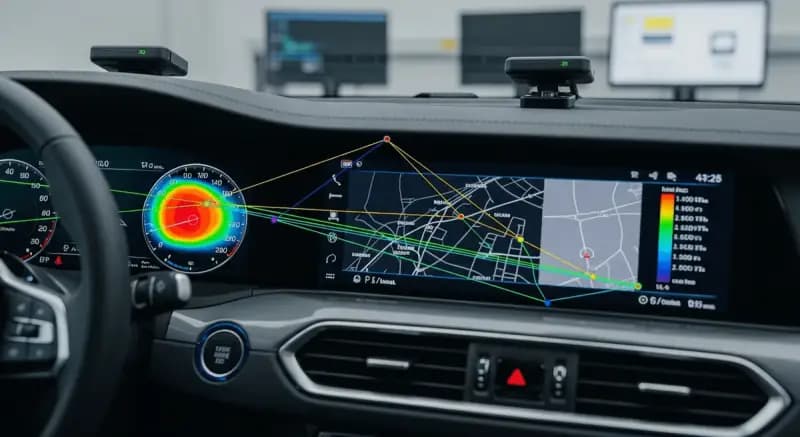
Abstract: This eye-tracking study evaluates cognitive load and visual attention patterns when drivers interact with various infotainment interface designs. Results indicate significant safety implications of design choices, with touch-based systems requiring 2-3x more visual attention than physical control interfaces.
Experimental Design
60 subjects completed standardized tasks (climate adjustment, navigation entry, phone dialing) across five interface types while driving simulator. Eye-tracking recorded glance duration, glance frequency, and total eyes-off-road time. Secondary task performance measured concurrent task degradation.
Results: Visual Demand
Physical controls: 0.8 seconds average glance time per interaction
Touchscreen with dedicated climate buttons: 1.4 seconds
Touchscreen with menu navigation required: 2.6 seconds
Voice control: 0.3 seconds visual, 4.2 seconds total interaction
Gesture control: 1.1 seconds
Safety Implications
Research indicates 2-second glances double crash risk. Menu-based touchscreen interactions regularly exceed this threshold. Physical controls rarely do. Interface design directly impacts collision probability.
Cognitive Load
Subjective workload ratings and secondary task performance confirm visual attention findings. Touchscreen navigation imposes significant cognitive load even beyond visual distraction, mental resources diverted from driving.
Design Recommendations
Frequently used functions should have physical controls. Touchscreen use should be limited to stationary-vehicle operations. Voice control shows promise but current implementation quality varies. Regulatory standards should incorporate interface safety metrics.
Source: Industrial Design Centre, IIT Bombay. (2024). Human Factors, 66(3), 521-538.
Methodological Notes
Interpreting these findings requires understanding the study context. Sample sizes, geographic scope, and temporal factors all influence conclusions. Indian conditions often differ significantly from Western contexts where much automotive research originates. Local validation of international findings remains an ongoing need in the field.
Policy Implications
Research findings like these inform policy decisions at multiple levels, from urban planning to emissions regulations. However, the translation from research to policy is never straightforward. Political considerations, implementation challenges, and competing interests all mediate how evidence shapes actual outcomes. Engaged citizens can advocate for evidence-based policymaking.
Curated by Nxcar with academic rigor. Our love for cars includes understanding their role in modern life.