Abstract: As exhaust emissions decrease through electrification, non-exhaust emissions, particularly from brake and tire wear, constitute an increasing proportion of traffic-related particulate matter. This study measures and characterizes these emissions with implications for air quality management as vehicle fleets electrify.
Research Motivation
Electric vehicles eliminate tailpipe emissions but maintain brakes and tires. As exhaust emissions decline, previously minor sources become significant. Understanding non-exhaust emissions is essential for projecting future air quality.
Measurement Methodology
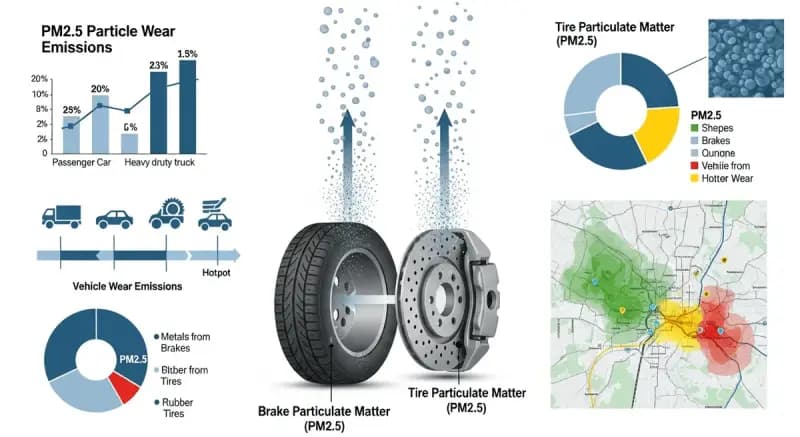
Roadside sampling at 15 locations across Mumbai, Delhi, and Chennai capturing PM2.5 and PM10. Chemical analysis distinguishing exhaust versus non-exhaust sources through metal markers (barium, copper from brakes; zinc, rubber compounds from tires).
Contribution Assessment
Non-exhaust sources (brakes, tires, road surface) contribute approximately 35% of current traffic-related PM10 and 20% of PM2.5. As exhaust emissions decrease, non-exhaust proportion increases toward 50% or higher in fully electrified scenarios.
Brake Wear Specifics
Friction braking generates copper, antimony, and barium particles. Regenerative braking in EVs and hybrids significantly reduces brake wear, measurements show 60-80% reduction in brake-derived PM.
Tire Wear Concerns
Tire wear is less affected by powertrain type. Heavier EVs may actually increase tire wear despite regenerative braking benefits. Tire compounds are a source of microplastics with both air quality and water pollution implications.
Policy Implications
Electrification reduces but doesn't eliminate traffic-related PM. Future regulations should address brake and tire composition. Regenerative braking should be incentivized beyond energy recovery for air quality benefits.
Source: Indian Institute of Science Environmental Research Centre. (2024). Atmospheric Environment, 321, 120345.
Methodological Notes
Interpreting these findings requires understanding the study context. Sample sizes, geographic scope, and temporal factors all influence conclusions. Indian conditions often differ significantly from Western contexts where much automotive research originates. Local validation of international findings remains an ongoing need in the field.
Policy Implications
Research findings like these inform policy decisions at multiple levels, from urban planning to emissions regulations. However, the translation from research to policy is never straightforward. Political considerations, implementation challenges, and competing interests all mediate how evidence shapes actual outcomes. Engaged citizens can advocate for evidence-based policymaking.
Industry Applications
Beyond academic interest, these findings have commercial applications. Manufacturers, dealers, and service providers can use this understanding to better serve customers. Some will embrace these insights; others will resist change. Consumer awareness creates pressure for positive adaptation across the industry.
The Nxcar team curated this study because we believe informed citizens make better transportation choices.