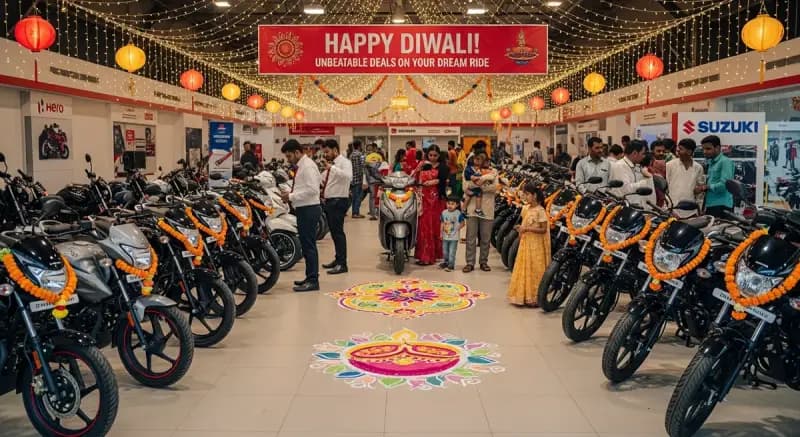
India's two-wheeler industry has recorded its highest-ever annual sales of 25.2 million units in fiscal year 2025, surpassing the previous record set in 2019. The achievement comes as the industry undergoes its most significant transformation since the transition from two-strokes to four-strokes in the early 2000s.
Data from the Society of Indian Automobile Manufacturers shows growth across all segments, but with dramatically different trajectories: conventional motorcycles grew 4%, scooters grew 8%, while electric two-wheelers exploded by 85%.
Electric Surge
Electric two-wheelers accounted for 2.2 million units of total sales, nearly 9% of the market. This represents a doubling from the previous year's 1.1 million units. Ola Electric led with approximately 400,000 units, followed by TVS iQube at 350,000 and Ather Energy at 200,000.
"The tipping point is approaching faster than anyone predicted," observes ICRA analyst Srikumar Krishnamurthy. "Electric could reach 25% penetration by 2027 at current growth rates."
Segment Analysis
The motorcycle segment remains dominated by Hero MotoCorp with 37% market share, though the company faces challenges from Royal Enfield in the premium segment and electric scooters at the entry level. Hero's own electric scooters have underperformed, prompting a strategic review.
Related Reading
Lidar vs Radar vs Camera Explained: Understanding Sensor Fusion in ADAS 2.5+ for Used Car BuyersHonda Motorcycle and Scooter India maintained its scooter leadership with the Activa, though the model's growth has flattened as electric alternatives gain appeal among urban buyers.
Rural-Urban Divide
A notable trend is the divergence between rural and urban markets. Rural areas, which account for 55% of two-wheeler demand, remain firmly committed to petrol vehicles due to limited charging infrastructure and preference for motorcycles over scooters.
Urban markets, particularly metros and tier-1 cities, are electrifying rapidly. In Bengaluru, electric scooters now account for over 20% of new registrations.
Manufacturers are developing parallel strategies: electric focus for urban markets while maintaining internal combustion expertise for rural demand that will persist for another decade.
Looking Ahead
As the Indian automotive market matures, developments like these reshape the competitive landscape. The coming years will reveal which players successfully navigate these transitions and which struggle to adapt. Consumers ultimately benefit from increased competition and innovation, though the transition period may bring uncertainty for some segments.
Industry Impact
This development carries significant implications for India's automotive ecosystem. Industry analysts suggest that the ripple effects will be felt across the supply chain, from component manufacturers to dealership networks. The competitive landscape is likely to shift as established players respond to market dynamics and consumer expectations evolve.
This story was handpicked by the Nxcar team, united by our fascination for everything on four wheels , from vintage icons to tomorrow's innovations.