The first Nissan Leaf offered 117 km of range in 2010. Today, premium EVs routinely exceed 500 km on a single charge. This 4x improvement didn't come from a single breakthrough but from hundreds of engineering refinements across battery chemistry, thermal management, motor efficiency, and aerodynamics. Here's how modern EVs achieve what seemed impossible a decade ago.
Battery Energy Density
The most significant factor is battery chemistry evolution. Early EVs used lithium manganese oxide (LMO) cells with energy density around 100 Wh/kg. Modern lithium nickel manganese cobalt (NMC) cells achieve 250-280 Wh/kg, a 2.5x improvement. This means the same weight of batteries stores 2.5x more energy.
Cell-to-pack (CTP) architecture further improves density by eliminating module-level housings. BYD's Blade Battery and Tesla's structural pack integrate cells directly into the vehicle structure, adding 10-15% more cells without increasing weight.
Related Reading
Auto Component Sector Achieves Record Exports of $22 BillionMotor Efficiency
Permanent magnet synchronous motors (PMSM) have replaced older induction motors in most EVs, offering 95-97% efficiency versus 90-93%. Hair-pin winding technology increases copper fill factor, reducing electrical resistance and heat generation. Oil cooling allows motors to operate at peak efficiency longer without thermal derating.
Advanced inverters using silicon carbide (SiC) semiconductors reduce switching losses by 50% compared to traditional silicon IGBTs, particularly at highway speeds where inverter losses dominate.
Aerodynamic Refinement
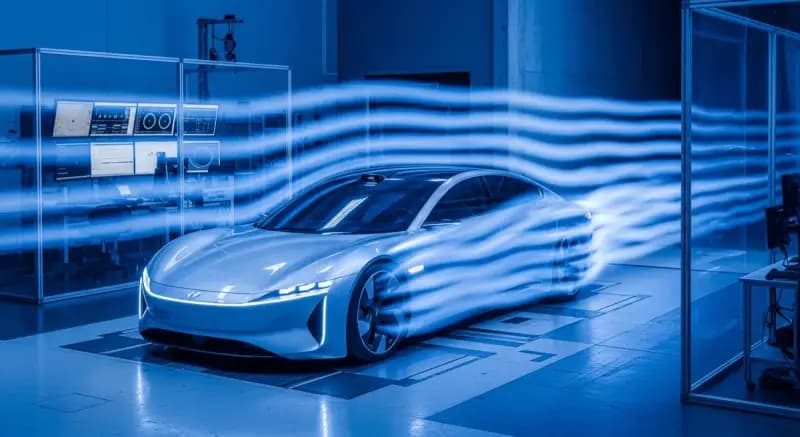
The Lucid Air achieves a 0.21 drag coefficient, among the lowest of any production car. This matters because aerodynamic drag increases with the square of velocity; halving the drag coefficient effectively doubles highway range from the same battery.
Active aerodynamics, grille shutters, adjustable spoilers, flush door handles, reduce drag at highway speeds while maintaining cooling when needed. Every 0.01 reduction in Cd adds approximately 5-8 km of range at 100 km/h.
Heat Pump Efficiency
Traditional resistive cabin heating consumes 3-5 kW, devastating for range in cold weather. Heat pumps extract thermal energy from ambient air, achieving 3x efficiency. The range impact of heating drops from 30%+ to under 10%.
Combined, these improvements explain how a modern EV with a 100 kWh battery can travel 600+ km when a 2012 EV with 24 kWh managed barely 117 km. Engineering, not magic, accumulated over a decade of relentless refinement.
Future Developments
Automotive technology continues evolving rapidly. What seems cutting-edge today becomes standard tomorrow. Understanding current technical foundations helps owners anticipate future developments and make purchase decisions that won't become obsolete prematurely. The pace of change, particularly in electrification and connectivity, makes this foresight increasingly valuable.
Related Reading
The Rise and Fall of Pimp My RideMaintenance Implications
Technical understanding translates directly to maintenance strategy. Knowing how systems function helps owners prioritize servicing, recognize warning signs, and communicate effectively with service advisors. This knowledge pays dividends throughout the ownership period, often resulting in better vehicle condition and higher resale values.
Technical Considerations
Understanding these engineering principles helps owners make better maintenance decisions. When mechanics explain repairs, informed owners can evaluate recommendations critically. This knowledge prevents unnecessary work while ensuring critical maintenance isn't deferred. The goal isn't to become a mechanic but to be a smarter vehicle owner.
Real-World Applications
Theory translates to practice in specific ways. Under Indian driving conditions, with their unique combination of heat, dust, traffic, and road quality, these technical factors manifest differently than in laboratory conditions. Owners should calibrate expectations accordingly, recognizing that advertised specifications often assume ideal conditions.
The Nxcar team curated this analysis with the same precision we admire in automotive engineering. Knowledge is the fuel for smarter decisions.